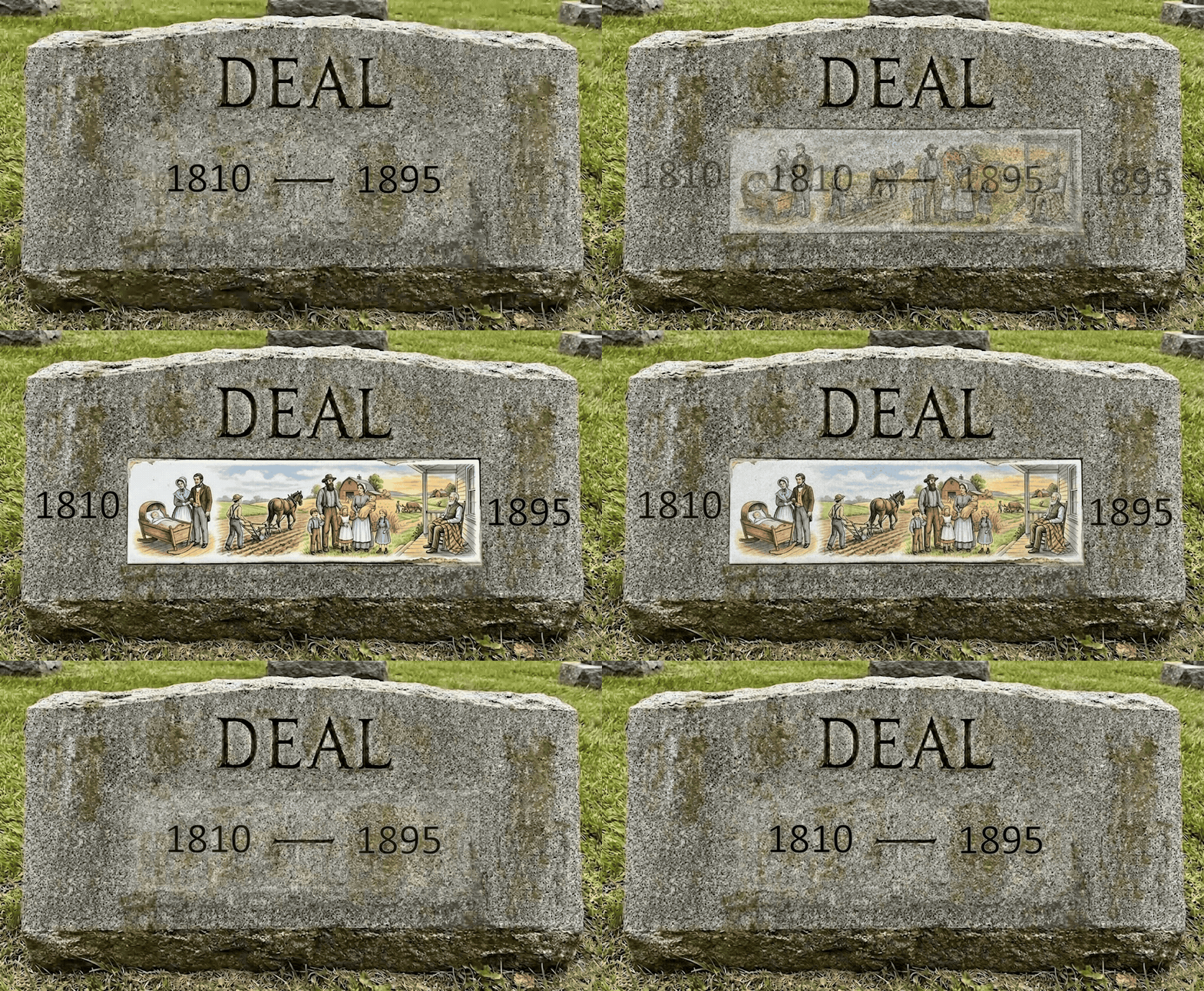
As we wander through any cemetery, we’ll find most headstones engraved with a name and a birth date and a death date. If we’re lucky, we’ll find some markers with additional information, sentiments, quotes or verses of scripture. But how do you capture a life on a tombstone? Nearly all grave markers will have a small, engraved dash between the birth date and the death date. As we research the lives of our family and ancestors, we come to realize that the dash is what we’re most interested in. The dash holds everything. First breaths, first love, family life, and final goodbyes. And so much more. These are the ordinary days and defining moments of a mortal life. The dates may mark when a life began and ended, but the dash tells the real story; how someone chose to live in between. What stories will you find when you discover the dash?
The story of Algernon Horatio Skingle Higbee is one of profound resilience shadowed by a haunting family pattern of tragedy. Born into a working-class family in London and orphaned before he could walk, Algernon’s life was a testament to the grit required to survive the 19th century and the cloud of heartbreak and despair that hung heavy over many lives In Victorian London.
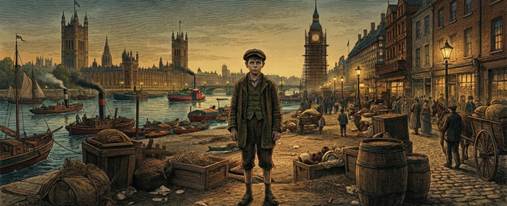
Algernon was born on June 8, 1858, at 65 King Street, Stepney. At that time, Stepney was a rapidly growing, densely populated, and impoverished district in East London. 1858 was also the infamous summer of “The Great Stink;” the Thames smelled so bad that Parliament actually had to shut their windows and finally get serious about fixing the city’s sewers and addressing the deadly cholera outbreaks. This was the world into which Algernon was born. And while London was busy dealing with its own problems, the Higbee family was about to face a much more personal series of heartbreaks.
Just two weeks after Algernon’s birth, his mother, Eliza James, died of puerperal mania. In the mid-19th century, puerperal mania (what we now recognize as a severe form of postpartum psychosis) was a terrifying and poorly understood diagnosis. In the smog-choked streets of 1850s London, medical science had no concept of hormonal shifts; instead, doctors often blamed the condition on “shattered nerves,” “moral shock,” or the sheer exhaustion of labor. For a young mother like Eliza, the sudden descent into a violent, confused state was often treated with little more than heavy sedation or confinement in a bleak infirmary. In an era before modern psychiatry, this “mania” frequently proved fatal, turning the celebration of a new life into a frantic and unrecognizable tragedy for the family left behind. It is hard to image what Eliza may have endured before her death.
Death Certificate of Eliza James Higbee 1858
Heartbroken and “unsettled” by the death of his wife, Algernon’s father, Horatio Higbee, a 22-year-old tobacconist, butcher and artist, sank into a “low and melancholy mood”. On December 18, 1858, when Algernon was just six months old, his father committed suicide by swallowing a quantity of prussic acid (cyanide) used in photography. He was found in his room by his mother, Jane Kirby Higbee, who noted he had become “disturbed in his mind” following his wife’s death.
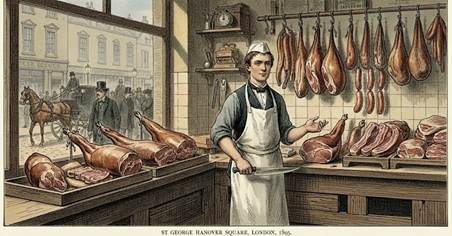
These tragic deaths left a 6-month-old Algernon an orphan. How it was decided who might raise him is left to speculation, but he was raised for a time by a step-aunt and her family, the Robinsons, in Spitalfields, London. The Robinsons were a family of pork butchers, so Algernon traded his father’s artistic aspirations for a blade and an apron. He grew up in the trade, learning the grueling, disciplined life of a butcher in London.
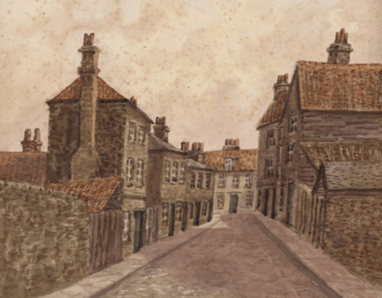
Despite such a chaotic start to life, Algernon seemed to have found a profession and an opportunity for a good life. Sometime around 1878, Algernon met and married Katherine (possibly Hammond) and began a life together as husband and wife in the quaintly named “Artichoke Alley” in Richmond, London.
Artichoke Alley, Richmond, painting from 1906
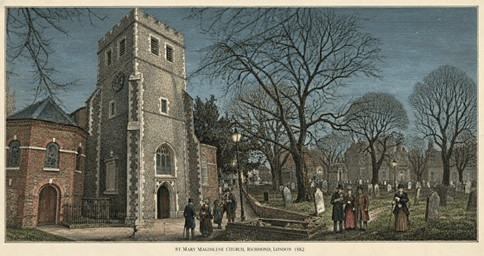
Algernon and Katherine soon welcomed a son, Hurbert, into the world. The 1881 census for Richmond lists Algernon, Katherine and Hurbert living at #4 Artichoke Alley. Perhaps this was a time of joy for the young family. This joy, however, was short-lived as tragedy again struck the Higbee family, when Katherine suddenly died just a year later in 1882 at 26 years of age from an apparent heart attack. Algernon was 24 and little Hurbert was 4. Katherine is buried just around the corner from their home, in the St Mary Magdalene Church cemetery in Richmond.
Death Certificate of Katherine Higbee 1882
Faced with the same painful void his father had encountered decades earlier, Algernon somehow chose to push forward. The fate of their young son, Hurbert, however, remains unknown, as he is simply lost to time. There are no records beyond his mention in the 1881 census record. One day, perhaps, we might find a reference to young Hurbert and a clue to his upbringing and fate. What life was like for Algernon at this time is only a guess. But a few years later, in 1886, Algernon met and married Rose Ann Froud and professionally transitioned from the butcher’s block to the steam and bustle of the London coffee trade.
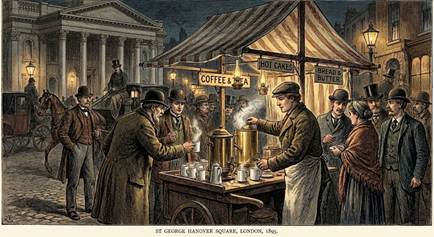
By 1895, Algernon was 37 years old and living at 33 Graham Street in Pimlico. He operated a coffee stall, a job that required him to be up in the predawn hours to serve the laborers and commuters of Westminster. However, records indicate that his health was failing, and the business he had worked so hard to build and maintain began to slip through his fingers.
To help make ends meet and assist with the heavy labor of the stall, the Higbees took in a lodger: James Silver, a young barber and an “old acquaintance” of Algernon. The living situation, as later noted in a news article about Algernon, was “extraordinary.” The Higbees lived in a cramped ground-floor room, and the only way for Silver to reach his own sleeping quarters was to walk through the bedroom where Algernon and Rose Ann slept.
The tension in the household was palpable. Algernon grew increasingly despondent, his mind “unsettled” by illness and the loss of his employment. On the night of Sunday, August 18, the air in the small room on Graham Street was thick with more than just the summer heat.
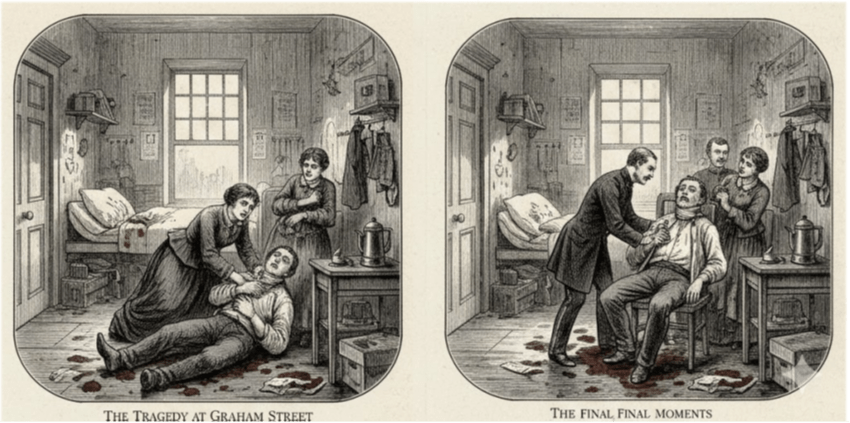
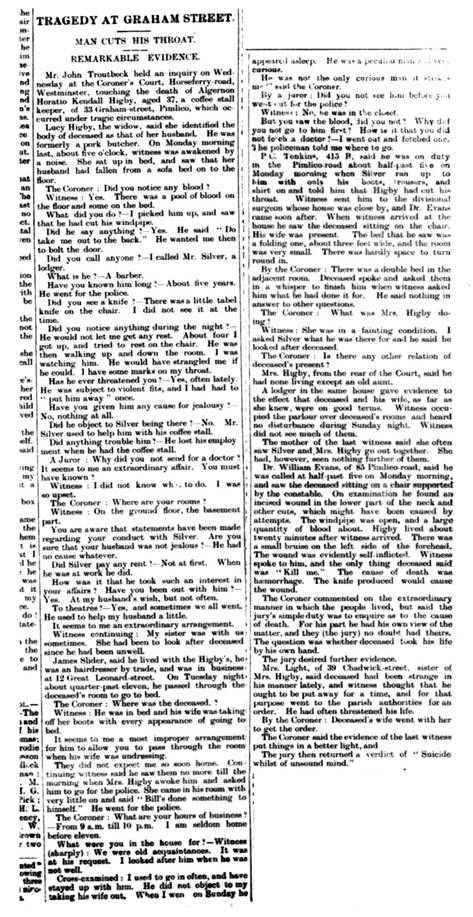
In the early Monday morning hours, the silence of the house was broken by the sound of a heavy fall. Rose Ann, who had been resting in an armchair because Algernon’s restlessness wouldn’t allow her to sleep in the bed, found her husband on the floor. In a desperate act mirroring the “temporary insanity” attributed to his father, Algernon had used a small table knife to cut his own throat.
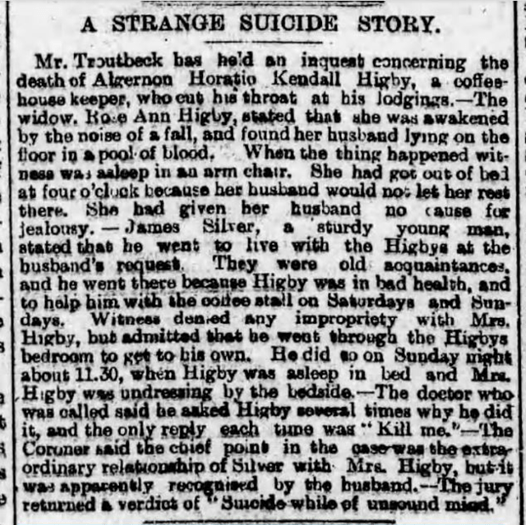
The news articles from the Westminster & Pimlico News painted a harrowing scene. Despite his horrific injuries, Algernon remained conscious for a short time. When the barber, Silver, arrived with a doctor, Algernon could only whisper a haunting plea: “Kill me.” He passed away twenty minutes later.
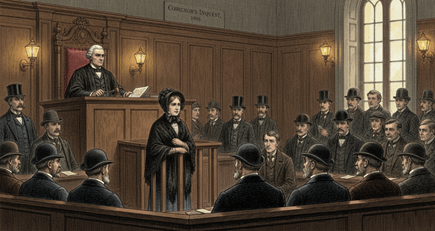
The subsequent Coroner’s inquest was a sensation of local gossip. The jury grilled Rose Ann and James Silver about the nature of their relationship, suspicious of the lodger’s presence in their bedroom. Yet the evidence pointed toward a man broken by the same “melancholy mood” that had claimed his father in 1858.
1895 Coroner’s Inquest
The jury ultimately returned a verdict of “Suicide while of unsound mind.” Algernon Horatio Skingle Higbee was a man who spent his life running from the shadows of his parents’ tragic ends, only to find those same shadows waiting for him. His story remains a heart-rending tale of the Victorian working class; a cycle of hard work, deep loss, and a family tragedy that proved too heavy to outrun.
Article detailing Algernon’s Death
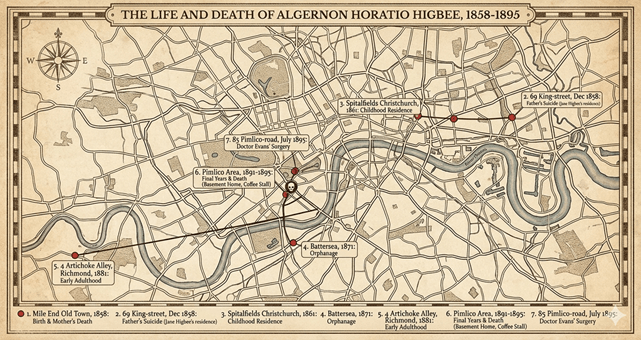
Article Detailing Algernon’s DeathMap of Algernon’s Life Events
SOURCES:
HIGBEE Algernon Horatio Skingle Birth Certificate 8 June 1858 son of Horatio Higbee.JPG
HIGBEE Eliza James Higbee Death Certificate 22 June 1858 wife of Horatio Higbee.JPG
HIGBEE Horatio London England Morning Chronicle 24 Dec 1858 Suicide Story from findmypast
HIGBEE Algernon Horatio Skingle 1861 Spitalfields Whitechapel London England census 2 years old living with half aunt uncle Robinson HIGBEE HIGBY.jpg
HIGBEE Algernon Horatio Skingle 1871 Battersea Surrey England census Orphan with Robinson family noted as Skendle Higby
HIGBEE Algernon Horatio Skingle 1881 Richmond Surrey England census noted as Halgon Higbee wife Catherine son Hurbert
HIGBEE Watercolor of Artichoke Alley in Richmond by F Viner 1906 Artichoke Alley noted as Algernon Higbee home in 1881 census.jpg
HIGBEE Katherine Death Certificate 10 Apr 1882 Richmond Surrey England wife of Algernon.JPG
HIGBEE Algernon living at Brewers Place in 1891 census near Victoria Station 1895 map metadata.JPG
HIGBEE Algernon H S Marriage Record to Rose Ann Frond or Froud St Mary Lambeth London England
HIGBEE Algernon H S Marriage Record to Rose Ann Frond 28 Nov 1886 St Mary Lambeth London England
HIGBEE Algernon Horatio London England Electoral Registers 1891
HIGBEE Algernon Horatio London England Electoral Registers 1893
HIGBEE Algernon Horatio London England Electoral Registers 1894
HIGBEE Algernon Horatio suicide article 22 Aug 1895 Rose Ann Higby wife.JPG
HIGBEE Algernon Horatio Skingle Death article Westminster Pimlico News 23 August 1895 page 5p.jpg
HIGBEE Algernon H K Death Index 1895 Saint George Hanover London England
HIGBEE Algernon Horatio Skingle Death Certificate 19 Aug 1895 noted as Kendall from GRO
William Veach of Delaware was my 6th great grandfather. According to the Veach Historical Society historical volumes, “William “Old Man” Veach was born about 1715 and was an “old man” in 1780 when he was charged with treason, which charge was dropped. An old man he was considered in that generation of Veaches, so short-lived were they, even though he was probably not over sixty-five years of age. He was well-to-do, as is shown by his assessment of 1785, when his taxes were the second highest of the Veaches in Cedar Creek Hundred. He owned more land than any of them; his holdings adding up to 560 acres. After the war was over, we hope that his last days were peaceful. He died between the years 1785 and 1790”.
I too hope that his final years in the newly formed United States of America were joyful and appreciative of the freedoms won through the many sacrifices made during that great Revolution. One could surmise that he might have seen the folly in backing the King and eventually felt some remorse for his traitorous decisions. On the other hand, he barely lived long enough to see the nation win its independence, let alone feel the freedom it eventually wrought. Perhaps he died never understanding the great cause of the American Revolution.
Below is William’s brief story connected to the Black Camp Rebellion of 1780 in Sussex County, Delaware. Let’s call it a little history with a hint of historical fiction.
The Price of Rebellion: William Veach and the Black Camp
The humid air of the Sussex County cypress swamps was thick enough to chew. William Veach stood on the edge of his acreage, his boots sinking into the dark, loamy soil that had been his life’s work. In 1780, the world was on fire, but in Delaware, the heat was personal.
For William, the “Revolution” didn’t feel like liberty; it felt like taxes and drafts. The newly formed Delaware state government was demanding men for the Continental Army and “Continental dollars” that were becoming as worthless as fallen leaves. To a farmer like William, whose loyalty was rooted in the land rather than a flag, the demand to fight for a cause that drained his barns was a bridge too far. Add to this, a summer drought that destroyed any hopes of a decent harvest, and you found farmers on the brink.
Word traveled through the pines in whispers. “Meet at the Black Camp.” William joined nearly 400 others; neighbors, kin, and fellow Loyalists who retreated into the dense thickets known as the Nanticoke Swamp. They weren’t an army; they were a collective of the frustrated. They hoisted a makeshift flag for King George III, not necessarily out of deep love for a monarch across the sea, but as a defiant protest of the local authorities who had started seizing property from those who wouldn’t pay the war tax. Around July 15 these men came together to discuss their own hardships and their frustrations over the war. They debated what they might do to remedy their situation. They discussed the recent British capture of Charleston and many suggested that most of the southern colonies from Maryland to Georgia were about to be secured by the British. Perhaps securing Sussex County for the British, as well, might earn them favor by the British.
At Black Camp, the air smelled of woodsmoke and desperation. William spent his nights around small fires, listening to the rhetoric of men like Bartholomew Baynum of Broadkill Hundred and William Dutton of Cedar Creek Hundred. They planned to resist the draft and protect their farms. For a few weeks, William felt the surge of a different kind of independence, a freedom from the “Patriot” officials he perhaps viewed as usurpers.
This rebellion, however, was short-lived. The state of Delaware, terrified of a Tory uprising in its own backyard, dispatched the Light Horse troop and a militia led by General John Dagworthy in August 1780.
The “Insurgents,” as the papers called them, were no match for organized cavalry. When the hoofbeats thundered through the brush, the Black Camp dissolved in the blink of an eye. William didn’t go out in a blaze of glory; he went back to his farm, hoping the shadows of the swamp would follow him home and keep him hidden. They didn’t.
By the time the court sat at Lewes, the fervor had turned to cold reality. William Veach and more than 200 more were hauled before the bench, charged with treason. The trial was a sobering affair. In the eyes of the new Republic, the refusal to pay taxes and these participants’ presence at the camp were acts of war against the state. 37 of the leaders were sentenced to death, to be “hanged, drawn, and quartered”. For William and many of the others, fines were imposed that perhaps were intended to be a slow, financial death. William’s fine was £2000, a sum that weighed more than any harvest his land could produce in a year. But at least he was not sentenced to death. For those 37 who were, good fortune came their way. Due to the fact that no one was killed in this rebellion, the state opted not to carry out these executions.
William and his co-defendants (many of his family, friends and neighbors) walked out of the courthouse “traitors” to some and “loyalists” to others, but mostly, they were just farmers who had tried to hold onto their world while the ground shifted beneath their feet.
William Veach returned to his fields, the weight of the fine a constant reminder that in a revolution, the cost of picking the losing side is paid in more than just blood, it’s paid in the very dirt you stand on. However, in November 1780, perhaps in an effort at reconciliation among the communities involved in the rebellion, the Delaware General Assembly issued pardons to all involved, William included.
The Black Camp Rebellion of 1780 is an often-overlooked chapter of the American Revolution. It wasn’t a battle of grand ideals fought by men in powdered wigs; it was a swamp-mired insurrection of farmers who felt squeezed between a King they had always known and a new government they didn’t yet trust.
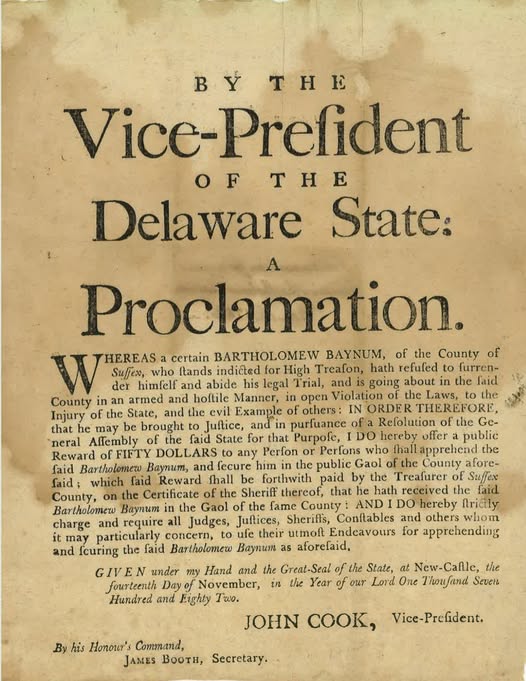
Below is the wanted poster for Bartholomew Baynum from Delaware’s state archives:
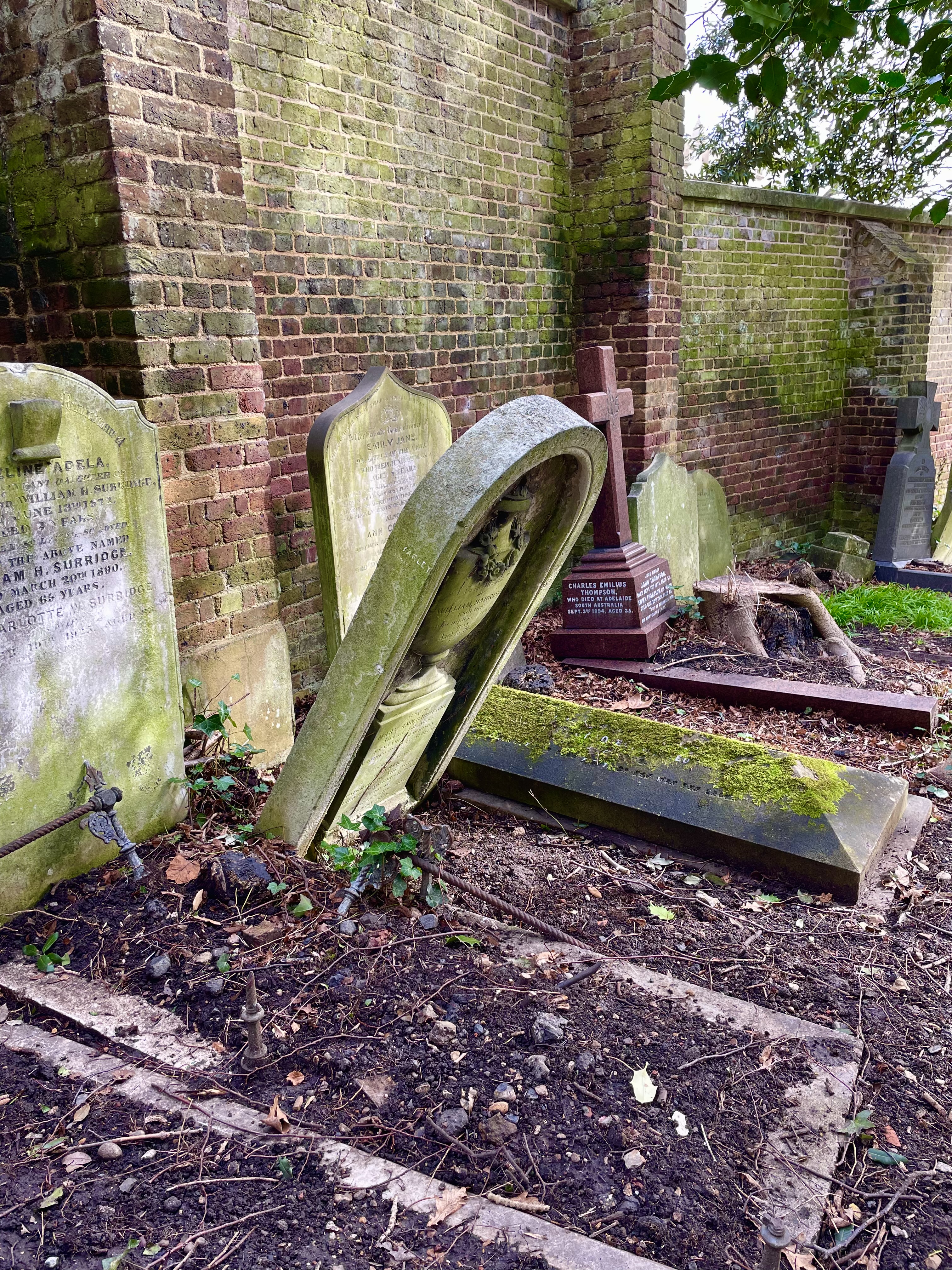
I love cemeteries. Not in a macabre or morbid way. I love them in the quiet, reverent way one might love great libraries or cathedrals of the world. Cemeteries are wonderful places, not because of architecture or ritual, but because of the stories that are buried in their soil. Every name carved into stone once belonged to a living, breathing soul. A person who laughed, and struggled, and prayed. Someone who had hopes, who made mistakes, who fell in love, and who tried to make sense of this mortal life.
Wandering through rows of headstones, I feel their presence. I feel a connection. Not just metaphorically. My faith leads me to believe that these souls live on, simply residing beyond a veil I cannot yet see through. Death, in that light, is not the end of the story. It’s a turning of the page. A transition to another chapter that is just as real, just as vivid. I believe they are aware. That they remember. That they still care.
There is deep romance in cemeteries, too. Not the candlelight-and-roses kind, but the enduring kind, the kind that carved “beloved wife” or “our darling boy” into stone because the ache of loss demanded it. Here are husbands who died in wars and wives who waited. Infants who never walked and mothers who grieved for decades. The young who left far too soon; the old who long faced life’s cruel challenges. And many in between. And yet, somehow, in every plot there is a sense of strength and resilience. Families endured. Love outlived sorrow.
What touches my heart the most, perhaps, is how these silent spaces refuse to stay silent. They whisper. They invite. They remind us that life is fleeting, yes, but also eternal. That we are part of a larger story that connects us all, on both sides of that veil of separation. I would think that, as we too eventually find ourselves beneath this sacred ground, we all want the same thing: to not be forgotten, but to be fondly remembered. And more than that, to look forward to that great day when we all finally meet again.
A letter by Almon Bates, from Lincoln, Nebraska, 26 Dec 1964, to a fellow soldier and friend, my great uncle, Nick “Odie” Odekirk. This is very much worth the read.
Dear Odie,
Nothing in all the world could have warmed my heart more this Christmas than to hear the sound of your voice on the telephone, Odie. My brother called me from Hygiene, and told me that Odekirk had called, and when the operator rang your number, I recognized your voice right off. Odie, I was afraid I would never get track of you after I didn’t hear after writing that card. Thought you might be somewhere else, or already answered last roll call.
Like I said, when I went back to Fort Bliss for the first time three years ago this coming March, stayed overnight in El Paso, and took a taxi out to the post at daybreak. I went in the Headquarters Troop barracks, looked around a little, got a drink from the same old drinking fountain and found the water as cold and sweet as ever. Then I walked down to the stables. The stables, stable shack, and blacksmith shop are still intact, but the corral, picket line, and water trough are gone. The corral area is enclosed in a chain link fence with army vehicles and material and equipment parked there. The little Chinese elm on the stable shack lawn had grown considerably, but the grass was thin and gone in spots. A stone had fallen out of the wall around the back of the shack. It really wasn’t too bad, but of course, the present occupants do not give the old stables area the loving care that we did.
One thing that seemed so strange was the silence there—the quietness. There used to be the hustle and bustle of morning chores at that hour. Now there was only stillness. I thought of the old gang—and the horses—wondered where they all might be—and who was still left. And, Odie, I was terribly homesick for a minute. Nostalgia gripped me—there was no one there that understood. A few soldiers in a strange uniform walked nonchalantly by, but they were of a different kind, a different breed—I resented them—they didn’t belong here. They were intruders. But then the first rays of the morning sun fell on the wooden beams that still protrude over the hay loft doors, and at the same time the fresh morning air stirred just a bit, and the fragrance of the desert, the sage, the yucca, and greasewood aroma drifted in just like it used to when we were all- young and there together. And so it was, the sun and the morning air and the purple Franklin Mountains in the distance, the old familiar buildings, the water tower, the barracks, the streets and walks that seemed to greet me, and I knew that the spirit of the cavalry still lived on there, and as I stood there, whispered, “Welcome home, trooper!”
And I stood in front of the old shop, gazing out across the corral toward the stable shack—and I fell to daydreaming—remembering—listening. Ah! The measured tread of marching men—the mounted platoon coming down from the troop for horse exercise. The voice of Sergeant Mace, “Platoon, HALT!” A sudden cease of footfalls. “Riiight FACE!” There is the scrape of leather boots soles on gravel, and then a metallic “click” as spur clad heels are slammed together. “Orderrr ARMS!” The slap rattle and thump of rifles—-
At the water trough is Stable Sergeant Inar F. (Swede) Larsen in neatly pressed O. D. shirt and breeches, campaign hat, highly polished brown boots, and gleaming spurs. In the next-door shop, the Machine Gun Troop shoers already have the forge going, and one can smell the coal smoke—-and there follows the musical “ding, ding, ding” of the fitting hammer on the great anvil.
There is a squeak of the steel gate to the alley between the stables of Hdqs Troop of the 7th, and the corral of C Troop, 8th Cavalry, as Stable orderly Moore swings the gate wide. Then, suddenly, simultaneously, there is a ”clop-clop-clop-clopping” of shod hoofs. the jingling of trace chains, and the rattle and rumble of iron tired wagon wheels on hard packed “caleche,” and in memory I could see the four line team of blacks, the high wheeled olive drab wagon, the morning’s load of stable cleaning piled high starting for the manure dump. Up on the spring seat dressed in baggy shapeless blue denims and droopy “sad Sack” fatigue hats are the Teamster, Odekirk, and Assistant Stable Orderly, Jose (Pancho) Quesada. The wagons always passed by the open door of the horse shoer’s shop.
Odie, I tried to remember the names of the four black “wagon” horses, but could only recall three of them. And then I thought I’d better try to write to you, as I knew your name was listed in the 1st Cavalry Division book. I think they were Blackie and Leo, the wheel team, and Midnight and Moon, the leaders. Do you remember the little sorrel horse I rode? His name was Juarez. He was from the Tate Ranch in Sheridan, Wyoming. I also rode a big tall off-colored brown horse for a while after I first came to the troop before we got in that little bunch of remounts that Juarez was in. The big horse was “Friar Tuck.” When I first came to the troop there were two of four original color bearers mounts. They were Silver and Speck. I rode Silver almost all the way through basic but rode Speck once or twice. Silver was an old horse, but real nice to ride. He had slick hair and was easy to groom, but Speck was hard to get clean. Old Friar Tuck was about the stoutest horse I ever rode in my whole life. I took him out one morning when I was in basic. Swede Larsen said- he had been bucking his riders off out in the desert and running back to the stables. He was a straight away bucker, but caught me on the downhill coming off a big old “bondock”. I had been doing a 1ittle contest riding the summer before and managed to stay above him. Later on, Swede had me ride a no-good little bay named Tennessee. He unloaded lieutenant Barton on the hard caleche in the troop corral by the gate next to the stable shack one morning. He would pull back, fall down, buck, shy, everything. A plumb no good, but Swede recommended me for PFC because I came down and rode him Sundays and off duty time, so got my first stripe that way. Other horses I can remember were Brownie, Blaze, Ole, Joe, Chief, Sergeant, Shotgun (Swede’s horse), Friday, Joe, and a brown or chestnut mare named Dolly, or Molly. She was the only mare in the troop, that is, among the public horses. I think she was the one that Swede once said was, “A good hose to ride, but had a wuff twot.” Swede was actually a Dane. He had soldiered in both the Danish and Swedish Armies. His mother lived in the old country in Copenhagen, Denmark. She always wrote to him. He was a real gentleman, always kind and gracious. Odie, you and Swede were the two at the stables I owe the most to. You were both mature men then, and I was just a punk kid that didn’t half know what the score was, and you two, especially you, Odie , helped me a lot by your good sound advice and council. We were like a family, for we shared with one another life’s joys and sorrows.
Odie, I remember you advised me to send $10 a month by allotment to my aunt who came to live with Dad and took care of my mother. You also urged me one bright Sunday morning to go down and call Mom long distance on Mother’s Day. I’m sure glad I did that–Thanks to you, Odie, because she passed away that September when we were in Australia. Odie, you were my best friend during our days there at the stables. You were my kind of folks—talked my language—knew what made me tick. I sure did laugh to remember how you and Pancho tied hard knots in my Levi pants legs. I never did get those knots undone. Odie, I was down in the because “The Girl I Left Behind Me” had thrown me over for some 4F, or draft dodger, and you fellows were trying to snap me out of it. I remember how you told me to forget her, she wasn’t worth worrying about. and you made the prophesy that I would someday find someone many times better, and honest and true, and I would be glad—which literally came to pass. I have.
Remember old Doc, the Mexican saddler? He was a good guy when sober, but had kind of an ornery streak when he was drinking. Once when he was acting stable orderly, he tried to breed Mrs. Hughes’ sorrel mare to Captain Hughes’ old black stud. Old Pete Marcell was Stable Sergeant then, but he was gone. I was there, but was down in the blacksmith shop. It was on a Sunday, and Doc had been drinking. He was always quarrelsome then, and wanted to fight. Mrs. Hughes jumped me about it the next day. I don’t know how she found it out. Maybe some officer was at Machine Gun Troop stable, or C Troop of the 8th.I heard the horses squealing and raising h–l, so ran out of the shop over to the box stalls, and tried to talk Doc out of it, but he wouldn’t, so I told him if he didn’t quit it, I’d report him. It made him awfully mad, and he wanted to fight me. He was real quarrelsome and disagreeable for a long time afterward. Mrs. Hughes was a real fine lady, and so was her husband. He was troop commander. I think you were there then, Odie. Mrs. Hughes used to help me shoe that sorrel mare. She was a nasty one on her hind feet.
No one could ever know what soldiering was like that wasn’t there. Especially in the old army—the old horse cavalry. Some of us may have appeared to be a little on the rough side, but that was only on the surface. Down underneath you would find the old horse soldiers were kindhearted—real men. Real he men. Here at college I look at these young boys that never knew what it is like to have hard going–I see them in long oily hair dos, fancy tight legged pants, pointed toed shoes with straps on the side, poor posture, sloppy manners, no courtesy, never hear one use the word, Sir, if they are about to get called in the army, all they do is feel sorry for themselves, if they already been, a lot of them just bitch about it—belly ache. It disgusts me, and, at times I find myself looking back and longing for the old days when I soldiered with real men. Odie, it was a privilege. Whatever life has in store for us from now on it makes no difference. We have had the fullness in the days we spent together.
Two years ago we went to Fort Riley, Kansas. The army still has one of the old cavalry horses there, a thirty-two-year-old brown named Chief. I gave him a hoof trimming job. He is the last of the old cavalry horses.
Last year (1963) in August we went to the 1st Cavalry Reunion in El Paso. My wife and two daughters wore “Yellow ribbons round their necks” and son, Andy, and I dressed in cavalry uniform. We also had a horse trailer and took one of our horses with. We had a McCellan saddle, army bridle, ect. Had a great time. I saw Harp. He· was 1st horseshoer ahead of me at Headquarters troop. He works at the post office in El Paso. Just got to talk to him a few minutes at the officer’s club. They had a dinner for us there. Bill Adams, troop commander in New Guinea was there. Also two or three others I kind of remembered. I never knew too many as was at the stables most of the time. After the war ended, I got home 17th of September, but didn’t get out right away as Fort Logan was not set up to discharge soldiers yet. So they gave me a two week furlough. Then I went back for discharge. I got out a PFC. Was a buck sergeant at Fort Bliss when I was regimental horseshoer. I never could get along with the last top kick, old LeGroane. He was a sure enough horse’s rear end, as was the last troop commander, Garrigan. Some of the fellows were still talking about Garrigan at the reunion. Said he never has come to any of the reunions, and no one ever heard from him. I used to think, and hope, that I would meet
up with Garrigan some day in civilian life when he didn’t have those silver bars on his shoulders to hide behind. Then I would ask him to fight like a man, for I would certainly challenge him. But now these twenty years have passed, and I suppose we are all a little humbler than we once were, and I would be glad today to see either LeGroane or Garrigan. But of all those I knew and soldiered with, Odie, you were tops in my book. Old Swede got to be a Major. He could speak five languages. Don’t know what happened to him, or how to get in touch. Pete Marcell retired from the army shortly after we left Fort Bliss. He owned an interest in a good cafe in El Paso and worked there as cashier for a time . Last report was he went to New York. He was a Greek—once fought for the welter weight championship of the world. Doc called him “Punchy Pete,” but not to his face.
I helped Dad and the boys at Hygiene for six years after the war. Then I started to school on the G. I. bill here in Lincoln at the Adult High School. Only got as far as the 8th grade before I joined the Army. Went to horseshoer school, poison gas school, and few others that counted for high school credits. I went evenings to the Adult High School, and days at the college academy here. I went 2½ years, finished all secondary classes but one, and got as far a second year in College. Have 50 semester hours done on the college level. It takes 128 to finish here to be an elementary school teacher. My wife, Agnes, is going to college now. She will graduate in May (65) with a teaching degree. She is a natural for a schoolmom. Met her here. We will be married twelve years in June. She wants to teach while I finish which will take me 2½ or 3 years. I sold my interest in the family trucking business to the rest of them ten years ago. My youngest brother died five years ago, so only three of us left. I ‘m the oldest. Dad is 75 now. My stepmother died four years ago. My aunt that took care of my mother is still living. She is passed 70 years. The boys haven’t done too good since I left them. It kind of took us all to make itgo. For a while we had it going real good, and it kind of looked like the Bates family might at long last be on the road to a decent degree of success and prosperity, but I think we muffed our only chance by not cooperating enough and sticking together. I have a nice new long wheelbase International with a 20-foot closed cattle body. I haul registered Angus and Hereford seed stock long-distance all through USA and Canada. Been at it ten years. Been through Salt Lake lots of times. Several times this fall in October and November. Unload and feed and water overnight at North Salt Lake stockyards lots of times. Summertime is pretty slack, and when we were in Colorado I did a good bit of horseshoeing in the summer, sold horse trailers, saddles, ect. 1961-62-63 was very good years for me and I got a little ahead, so moved my family here in January this year to put my wife on through college. That way she can help me educate the kids when the time comes, as I got them a little late in life. The draw back to my long-haul business is that it is irregular, undependable, and when it is good, keeps me away from home weeks at a time. My wife would like to get me into something else—like teaching. I don’t know how I would do at it. She is good… she is a very fine lady, and we have three nice kids. My wife is a very pious Christian woman. Kind of like I imagine your people were. She has worked very hard to convert me since we have been married, and even before, but I still do not seem to be any nearer to being a believer than I ever was. Can’t seem to find God “In the light that’s sifted down through tinted windowpanes,” but rather in the smell of sage after a rain, or purple mountains in the distance, the prairie grass, cottonwoods, a cow’s bawl, or a donkey’s bray, or the feel of a good horse under me, or the open road ahead. To listen to a long sermon and a lot of complicated Bible interpretation and doctrine that I question just leaves me empty and dissatisfied. I like to see Old Glory flying in the breeze, and I find myself listening as General MacArthur said, “Vainly, but with thirsty ears for faint bugles in the distance,” and the band music of “Garry Owen” and “The Monkey Wrapped His Tail Around The Flag Pole.” When my final orders come through, and Taps is sounded, all I ask is to be permitted to sleep the long sleep with those of my own kind—American soldiers— “ Under the sod and the dew waiting for the Judgement Day.”
Odie, I am sending in a membership for you in the 7th Cavalry Regimental Assn. I see you are a Charter Member in the division Association. I will pay for your 1965 dues which is my Christmas present to you, Old Friend. The Commanding Officer will probably send you a form to fill out. Be sure and get it filled out and sent back. Get someone to help you, if need be.
Now, next time I get a trip to the west coast, I am coming back through Salt Lake and will hunt you up. We will have a good visit, Odie, just like back in the old days.
There will be another reunion in Fort Bliss in 1968, and I want you to plan on coming to it, and we will drive out to Salt Lake to get you if need be.
Many thanks for the phone call, Odie. If you ever need help bad, get in touch with me. Take care of yourself, and if you can, come and see us.
Your buddy,
Garry Owen!
Almon R Bates
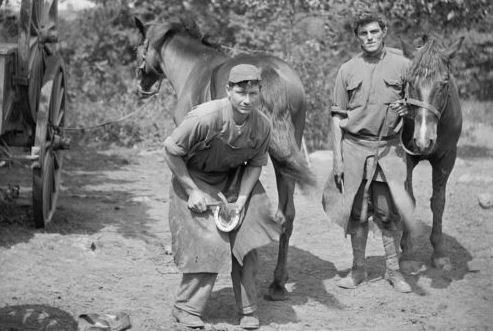
WWII Farriers
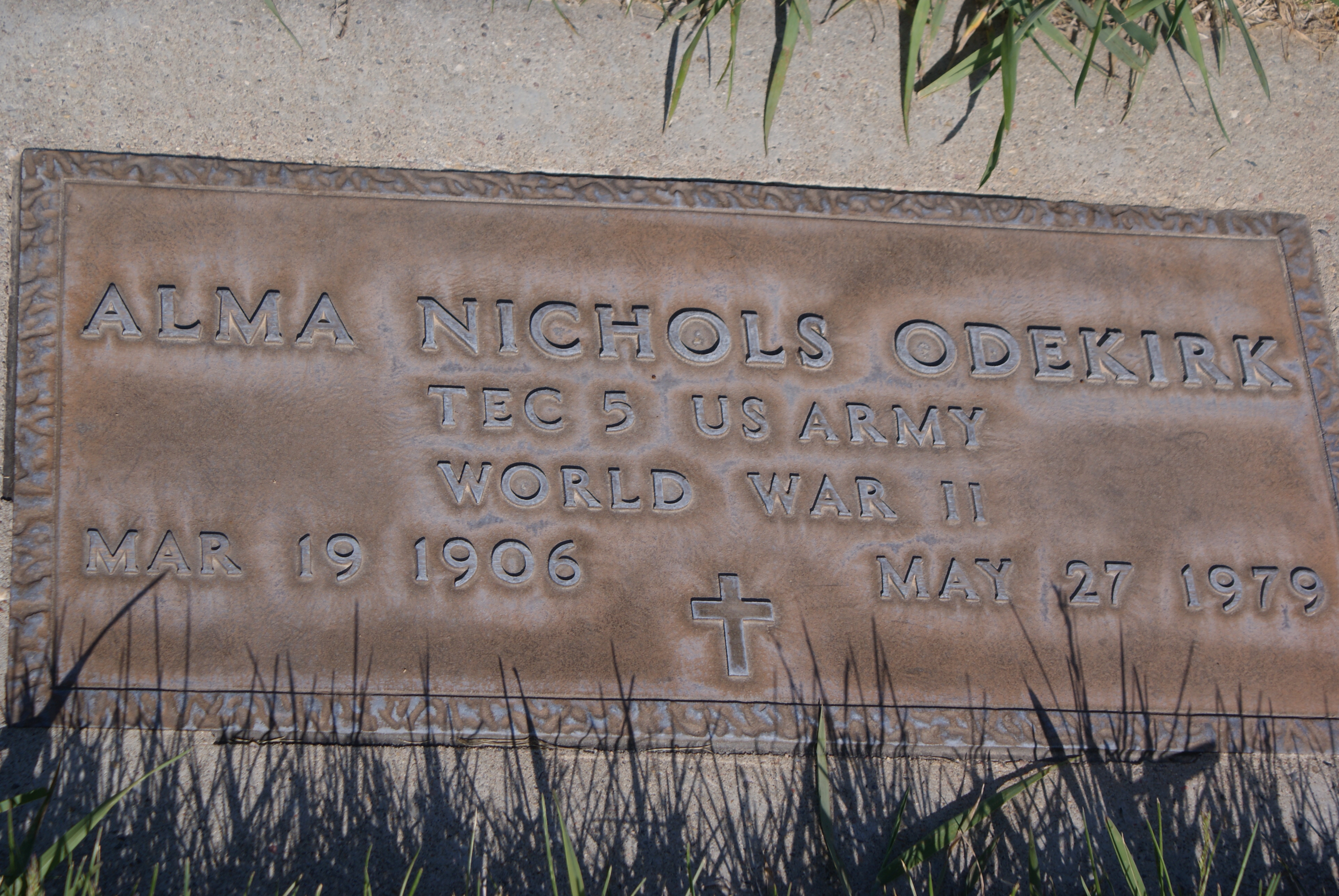
NOTE: Odie was my great Uncle Nick, Alma Nichols Odekirk. This letter was written to him by his Army buddy, Almon Bates, who passed away in 2005. This letter was so poetic, insightful and interesting, it needed to be shared. I hope it speaks to you as it has to me.
While searching the Internet a few years back, I stumbled across the WWII Memorial website, (wwiimemorial.com) dedicated to the registry and recognition of all WWII veterans. I checked the searchable database for the names of a few relatives and found very few listed. I did find a reference for my great-uncle Nick, Alma Nichols Odekirk. The site merely indicated that he served in the Army. A reference at the bottom mentioned that his name was submitted by Almon R. Bates, “a friend”.
I had never heard of Almon Bates, so I looked him up in the white pages on the Internet. I found a single reference; he was living in Colorado. I took a chance and called the number and asked for Almon.
The woman who answered indicated that she was Almon’s wife, Agnes, and wondered if she could help me. When I explained the purpose for my call, she sadly let me know that Almon, her husband of nearly 50 years, had passed away that past January. He was 84 years old. I offered my condolences and asked her if she knew my Uncle Nick. Gleefully, she acknowledged that she did; she knew him as “Odee”.
Odie and Al (Almon) were stationed together at Ft Bliss in El Paso, Texas, probably in 1940 or 1941, before the war. They were both with the 1st Cavalry. Ft Bliss housed 10,000 head of horses that were used by the Army at that time. Odie and Al were both assigned to the Stable Police. Al shoed the horses and Odie was a manure spreader. They lived in the old brick stable shack. There were 5 or 6 others who worked with them. The rest of the troops, those who “rode” the horses that Nick and Al cared for, lived in the barracks up the road.
When Odie and Al went overseas, they no longer worked directly with the horses or mules. Al was a driver for senior commanders, and Odie was assigned to the Communications area, tasked with the job of keeping communication lines open at the front connected to the commanders at the back.
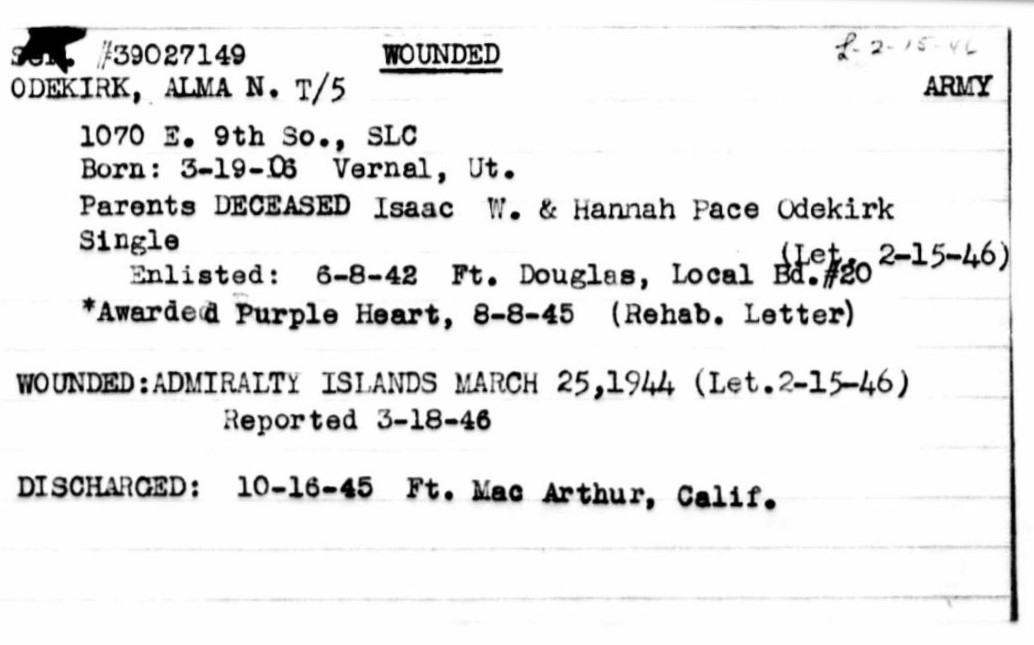
It was in this job that Odie was injured and for which he received the Purple Heart. Odie had been hit in the face, either by a bullet, or by shrapnel, and was seriously injured. Regardless, he hunkered down and continued to fulfill his assigned tasks. Agnes said he was a true hero! She thinks he likely had many other similar experiences of heroism. His injury required war-time surgery to repair the damage done, particularly to his nose. Al later joked that “his nose looked better after the injury than before”.
Agnes told me that Al fought in 35 battles, through 3 campaigns in the Pacific. She thought that Odie fought in more. Agnes knew that Al had received a Bronze Star and was sure that Odie had received something even “higher.”* Agnes noted that they had so many stories to share of the war and their experiences. They said these two found time to “horsed around” a lot, though they were serious and dedicated when duty called. They had to exhibit a sense of humor to get through what they were facing day to day.
Al and Odie shared many experiences, forging a camaraderie and friendship that lasted all their lives. Each would visit the other after the war; Odie traveling to Texas or Colorado, and Al and Agnes traveling to Salt Lake City. Odie and Al would even travel together on occasion for work or other reasons. Al loved Odie (who was Al’s senior by 12 years). Agnes, of course, had the chance to know and love Odie as well over the years. She had nothing but kind things to say about him. She said he was very well liked by many people; that he had a good head on his shoulders. She also remembered that he was quite a baker and cook.
She recalled a story Odie had once related from his youth. A poor, elderly neighbor man was quite ill. Odie’s father, Isaac W. “Ike” Odekirk, offered to take the gentleman in and allowed him to stay in a small cabin that the family owned. Each of the boys took turns caring for this man; feeding him, gathering firewood, and other duties associated with caring for him. Nick, at 16, willingly obliged. Agnes was very impressed with Nick’s sense of duty, even at that young age.
Agnes asked me if I had ever seen Odie’s World War II scrapbook. She said that it was one of the finest she had ever seen. It included photographs, menus, clippings, enemy propaganda, and all sorts of other items. It was remarkable. Nick had shown it to them on one of his visits to their home, and had actually asked Al to keep it, stating that they had a good home and a place to keep these memories. Al was not comfortable accepting such a fine gift and refused. Agnes heard that on Nick’s return trip to Salt Lake the book was lost. She had hoped after all these years that that was not true and hoped that I knew of the scrapbook. I did not. She wished that Al had agreed to keep it all those years ago.
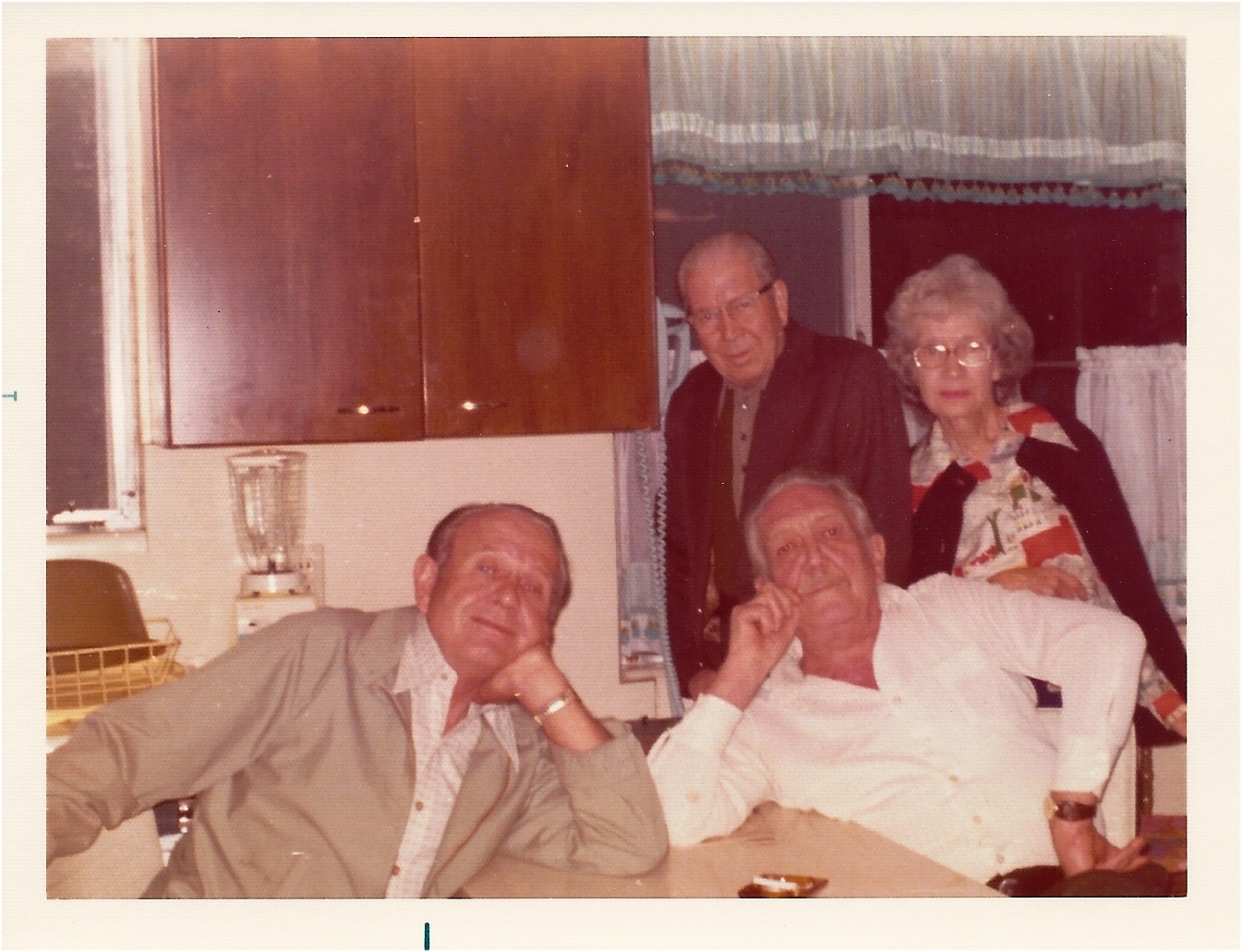
Nick, front right, with his brothers, John, left, Babe, center, and his sister, Mary
When Nick passed away in 1979, she thinks it was one of Odie’s nieces that called and told them. She and Al were both saddened at his passing. It seemed a joy for Agnes to reminisce about those old friendships. She said she had actually just thought of Odie a few days before my call. “What a great man”, she said. I’m heartened that Odie was so alive in Agnes’ memories. I hope that he remains that way for all who knew him. I’m appreciative that Al thought enough of my Uncle Nick to ensure his name was listed on the WWII memorial site. Agnes told me she planned to be at the dedication of the WWII Memorial in Washington DC. I hope she made it. Odie and Al were clearly part of the “greatest” generation.
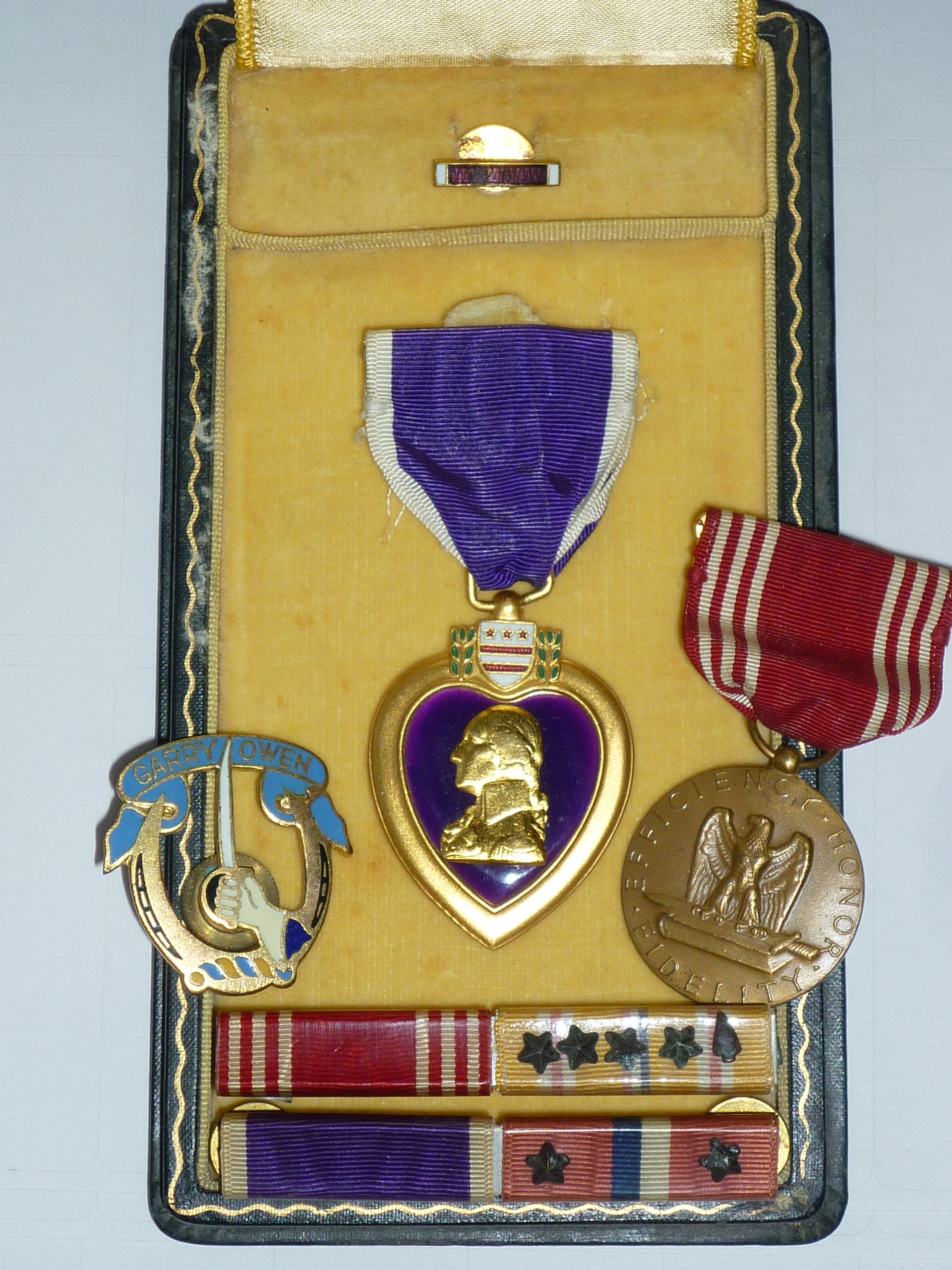
* I do not find record of Nick’s Bronze Star, but I do have his other ribbons and medals, including his Purple Heart, his Army Good Conduct Medal, his Asiatic-Pacific Campaign Medal with 5 clusters, and his Philippine Liberation Ribbon with two clusters.
On this Memorial Day 2021, as we honor those who have died in the service of our country, I am remembering a second cousin on my father’s side, 1Lt James Norwood Amos. James fought with the 357th Infantry Regiment, 90th Infantry Division in WWII. He was among the many that stormed the beaches of Normandy in June of 1944. While he survived the beach landing, he was killed 30 days later, on July 6, 1944, as the 357th “attempted to take Beaucoudray, a small town whose capture was to develop into one of the toughest engagements to the entire war. This six day battle saw the type of slugfest which is so costly to both sides”*. He is buried in the Normandy American Cemetery, Colleville-sur-Mer,. Basse-Normandie, France. He made the ultimate sacrifice. I salute him for his valor. And I honor all of those who served and died so courageously.
The grave marker is in the Normandy American Cemetery and Memorial. The two portrait pictures are James’ Junior and Senior High School portraits. The picture in uniform is noted, online, as being James. I do wonder about the uniform, however. His military record clearly shows he was with the U.S. Army. This appears to me to be a Navy uniform. Am I mistaken? Could this photo be attributed incorrectly?
*Regimental History of the 357th Infantry; Compiled by SSgt. George von Roeder; First Edition printed by the Ferdinand Nicki Buchdruckerei Weiden, Oberfalz, Bavaria
According to her death certificate, Annie Margaret was born March 30, 1863 in what other family records indicate was New Baltimore, Somerset County, Pennsylvania. On December 17, 1912, at 44 years of age, Annie died in Buffington, Fayette County, Pennsylvania. Her death was caused principally by typhoid fever, with complications of pneumonia.
Annie married Samuel Mears Deal, January 1, 1880, in Wittenburg, Somerset County, Pennsylvania. Samuel and Annie Deal went on to have twelve children. Much of Annie’s recorded life notes a maiden name of Null.
Despite finding numerous references in several vital records noting Annie’s maiden name as Null, when she died in 1912, her husband, Samuel, was the informant and noted her parents as Ellen Logue and Samuel Cooster, both of Pennsylvania. So how does this Samuel Cooster fit into the picture and where did the name Null come from? A search has led to some interesting information.
Firstly, Cooster is an unusual surname, and is found very infrequently in early Federal census records. There were less than 35 individuals in the 1860 census with this surname; none named Samuel, and none from Pennsylvania. Generally, this name would appear to be the phonetic spelling of the western Pennsylvania pronunciation of the surname CUSTER, like rooster. Cooster is found in a few local Somerset county records, such as early baptism records, but here too it appears to be a misspelling of the name Custer. Also found are the similar surnames Kuster, Castor and Cusner, but all three seem to refer generally to the same family name, Custer. This fact has led me to the conclusion that Annie’s father was perhaps a Pennsylvanian named Samuel Custer. While there were several Samuel Custers in the Somerset County area at the time of Annie’s birth, no records have yet been found to show a marriage between a Samuel Custer and Ellen Logue.
Annie’s mother, Ellen Jane Logue, was the daughter of Isaac Logue, and is found in several Somerset and Bedford county records. Ellen was born in 1842 in Bedford County. She can be found in early census records living in the home of her father. Ellen was the fifth of eight siblings.
As previously noted, no marriage records have been found for Ellen Logue and Samuel Custer. However, a marriage record has been found for Ellen Logue and David Null, married January 1, 1870 in Somerset County. That same year, a census record shows David Null, aged 19, and Ellen Null, aged 26, with a daughter Annie, aged 6, living in Southampton Township, Somerset County, Pennsylvania. Annie’s surname is not listed, but is referenced by a ditto mark (“) in the census. This Annie’s age coincides with the birth year noted in Annie Margaret’s death certificate, indicating a likely match. This record indicates, if common sense prevails, that Annie is not the daughter of David Null, as David would have been too young to be Annie’s father. It would seem more likely that David is her stepfather. Is it possible that this Ellen Logue, and daughter Annie, while coincidental, are not the Ellen and Annie in question? While it could be suggested that this Ellen Logue Null is not the same Ellen Logue as listed on Annie’s death certificate, two other Deal records would suggest otherwise.
In an unrelated military record of Annie’s son Samuel Grant Deal, it notes that his mother’s maiden name was Null, not Cooster as listed on her death certificate. A separate record for son Charles Milton Deal indicates the same name, Null. This clearly creates a link between Ellen Logue in both records, connected to Null and Custer. This information would suggest that the Ellen Logue who was married to David Null was the same Ellen Logue listed as Annie Margaret’s mother on Annie’s death certificate.
What then of the Samuel Custer listed on her death certificate? Was he married to Ellen Logue some time prior to her marriage to David Null? Then divorced? Or widowed? Or did they perhaps have a child out-of-wedlock? No records have been found that would clarify these questions. Records have shown that at the time of Annie’s birth there were six different Samuel Custer’s in and around the Somerset area. This document attempts to pinpoint, which, if any, of these Samuel Custers is most likely to have been the father of Annie Margaret Deal.
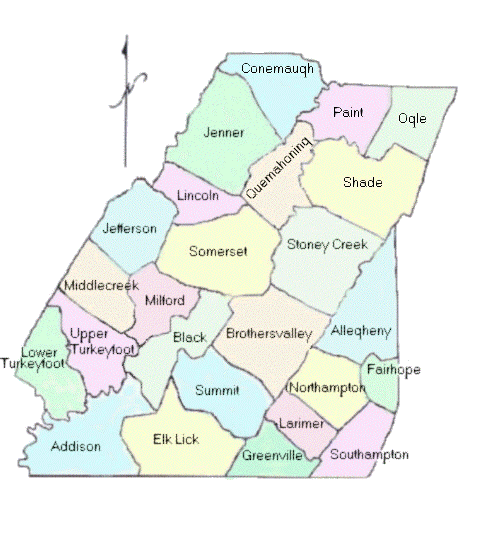
In 1850, according to the Federal Census, there were four Samuel Custers living in Somerset County, Pennsylvania. Samuel Custer (1) was born about 1814 and was living in Conemaugh Township. Samuel Custer (2) was born about 1824 and was living in Paint Township. Samuel (3) was born about 1828 and was living in Stoystown. Samuel (4) was born about 1838 and was living in Stoneycreek Township. There were no Samuel Custers in Bedford County to the east and none were found in Westmoreland County to the west. There was a Samuel Custer (5), born about 1833, living in Richland, Cambria County to the north. In 1850, Ellen Logue was living in Harrison Township, Bedford County, some 12 miles away from New Baltimore, Allegheny Township. Somerset, where daughter Annie would eventually be born.
Samuel (1) about 36 years old 28 years senior to Ellen 40 miles from New Baltimore
married with children
Samuel (2) about 26 years old 18 years senior to Ellen 25 miles from New Baltimore
married with children
Samuel (3) about 22 years old 14 years senior to Ellen 17 miles from New Baltimore
not married
Samuel (4) about 12 years old 4 years senior to Ellen 5 miles from New Baltimore
Samuel (5) about 27 years old 17 years senior to Ellen 27 miles from New Baltimore
Figure 1 Somerset County Townships
By 1860, Ellen and her family had moved to Allegheny Township in Somerset county. Ellen was approximately 17 by this time. Just three years prior to the time Annie was born. Whether they were living in or around New Baltimore is not certain. The 1860 Federal Census indicates the status of the various Samuels by 1860:
Samuel (1) appears to have died by 1860. His wife and daughter are now living in Paint Township. Samuel is not found in the census.
Samuel (2) was still living with his wife and children in Paint Township.
Samuel (3) was still living in Stoystown, Conemaugh Township, now with a 20-year-old bride. This Samuel also became a well-known innkeeper in Somerset County.
Samuel (4) nor his parents are found at all in the 1860 census. Samuel (4)’s first cousin, Fredrick, however, was living just 4 houses down from Ellen and her father in 1860. It is curious as to where they may have gone. It seems that the 1860 Somerset census did miss counting a number of families.
Samuel (5) was now living in Paint Township, Somerset County, and was now married with children.
Also found in the 1860 census was one other Samuel Custer. Samuel (6) was born about 1805 and was living in Jenner Township. He can be summarized as follows:
Samuel (6) abt 55 years old , 38 years senior to Ellen and living about 27 miles from New Baltimore. He appeared to be widowed with children.
By 1870, Annie Margaret would have been six years old herself, being born in 1863. Her mother, Ellen, had just married David Null at the beginning of the year. The census for that year shows Ellen living with her new husband and daughter, Annie, in Southampton Township, Somerset county.
Samuel (1) had died more than a decade before. This reasonably eliminates him from being Annie’s father.
Samuel (2) was still living in Paint Township with his wife of over 20 years. He still had children living at home according to the census.
Samuel (3), the Innkeeper, continued to live in Stoystown with his wife of more than 20 years as well. He also had children living at home in 1870.
Samuel (4) was now living in Allegheny Township, the same location where Annie was born. This census indicates that by this time he was married with four children. Coincidentally, his wife, Mary Stull, was the same age as Ellen Logue, and the census shows that Samuel’s eldest child was approximately the same age as Annie Margaret.
Samuel (5) appears to have left Somerset county, and by 1870 was living with his wife and children in Richland, Cambria County, some 40 miles north of New Baltimore.
Samuel (6), who would have been about 65 in 1870, is not found in the 1870 census. It is presumed that he was dead by 1870.
So will the real Samuel Custer please stand up!
Perhaps none of the Samuels listed are actually the father of Annie Margaret. Further research may eventually provide some additional clues. Perhaps an early marriage reference; perhaps a legal proceeding related to an unwed birth. These types of records may provide more definitive answers. Short of that, surmising the father might be the only course for now.
Samuel (1) appears to have died prior to the time of Annie’s birth. This would eliminate him as the father.
Samuel (2) was 18 years Ellen’s senior, was married, and lived a fair distance from New Baltimore. There does not appear to be any connection to Ellen or her family. This could rule him out.
Samuel (3) was about 14 years Ellen’s senior, was also married, with children, and was a prominent business man. He remained in Stoystown, a fair distance from New Baltimore, and remained there until his death. A biography of this Samuel is noted in the Histories of Somerset and Bedford counties. No reference is made of Ellen Logue or Annie Margaret. It seems unlikely that this Samuel is Annie’s father.
Samuel (5) was originally from Cambria County, but in the 1860 census was living with his wife and children in Paint Township, Somerset County. Ellen Logue did not live in Paint Township, and appears to have had no relation to that area of the county. By 1870 this Samuel as back in Cambria County. There would appear to be no reasonable connection between this Samuel and Ellen.
Samuel (6) was nearly 40 years Ellen’s senior, and though widowed, appeared with his children only in the 1860 census. They were living in Jenner Township, in the northern part of Somerset County. Ellen did not live in or around Jenner Township. As with Samuel (5), there appears to be no connection between this significantly older Samuel and Ellen.
Samuel (4) is probably the most likely to be the Samuel Cooster listed on Annie Margaret’s death certificate. His age most closely matched Ellen’s. He lived only five short miles from New Baltimore in 1850. While neither he nor his parents are found in the 1860 census, he did have a cousin that lived just houses away from Ellen in New Baltimore, Allegheny Township in 1860. By the 1870 census, he is living in Allegheny Township, where he resided until the time of his death in 1890. With this information, it is surmised that this Samuel Custer, son of Henry Custer and Margaret Hart is most likely to be Annie Margaret Custer Deal’s father.
Ancestry research on each of these Samuel Custers is interesting. All six are related, some rather close, some a little more distant. But they all tie to an early Pennsylvania Custer.
DNA testing on my line shows a clear and close connection to many of the descendants of these same Samuel Custers. There is no doubt that the Cooster/Custer noted on Annie’s death certificate is accurate. The proof is in the DNA. However, DNA has yet to prove exactly which Samuel was her father. My closest DNA connections to the Custer line are more frequently the descendants of Samuel (4), so I do believe that I have surmised correctly. However, I will continue to seek further information that may prove this guess to be accurate. So the search continues!
John Nunn was my second-great Grandfather. He was born about 1836 in Suffolk County, England. His daughter, Mary Ann Nunn, was born July 11, 1870. My mother (Mary Ann Higbee, b 1927-d. 2008), also born on July 11, was named after Mary Ann, her grandmother. In the following document, I will attempt to detail what can be gleaned from family and vital records to suggest who may be the parents of John Nunn. I begin with a chronological list of information we have on hand:
1870: Great Grandmother, Mary Ann Nunn, was born in Brompton, Kent, England on 11 July 1870, to John Nunn and Mary Ann Moore [see the copy of her birth certificate].
At the time of her birth, John Nunn and Mary Ann Moore Nunn were on Manor Street in Brompton. John Nunn was listed as a Sapper with the Royal Engineers. This is an important bit of information.
1871: In the 1871 England Census [see copy of 1871 census], John Nunn, wife Mary and daughter Mary can be found in the Chatham, Brompton, Kent census. John is noted at 37 years old, and Mary as 25. Daughter Mary Ann is 9 months. John’s occupation is listed as Royal Engineer Smith. John’s birthplace is listed as Easton Market, Suffolk, England. Research into English place names shows that there is no known location in Suffolk called Easton Market; however, there is a location called Needham Market. This is worth noting as other records for John Nunn note Needham Market, Suffolk.
Mary Ann Moore Nunn’s birthplace is listed as Nunsbridge (or something similar), Devonshire. Nunsbridge does not exist; neither in Devon, nor in any location in England. It would seem that this is an incorrect recording and transcription. Devonshire, however, also does not match our general assumption (based on other family information) that Mary Ann Moore was born in Kent. Of course, the census could be wrong.
Nine-month-old Mary Ann Nunn’s birthplace is listed as Brompton, Kent which ties to her birth certificate information, as noted previously above.
1872: Two years later, on 26 February 1872, as sister was born, Emma Jane Nunn, to John Nunn and Mary Ann Moore Nunn. John was still noted as a Sapper Royal Engineers. They were living at 24 Manor Street in Brompton [see the copy below of Emma Jane’s birth certificate].
Family lore tells us something interesting about the upbringing of Mary Ann Nunn. Marjorie Jane Higbee Brady (my aunt), in her written history of her father, Clifford Higbee, mentions that John Nunn and Mary Ann Moore Nunn divorced at some point, and that their daughter, Mary Ann Nunn (born 1870), was raised by her Uncle Charles Nunn and his wife Emma [below is an excerpt of this reference in the history of Clifford Higbee by Marjorie Higbee Brady].
That John Nunn had a brother Charles, and that Charles and his wife raised Mary Ann, is important information that coincides with what Doris Odekirk Higbee (my grandmother) shared with me as well, as we discussed genealogy in year’s past. This relationship is partially corroborated in the following two records:
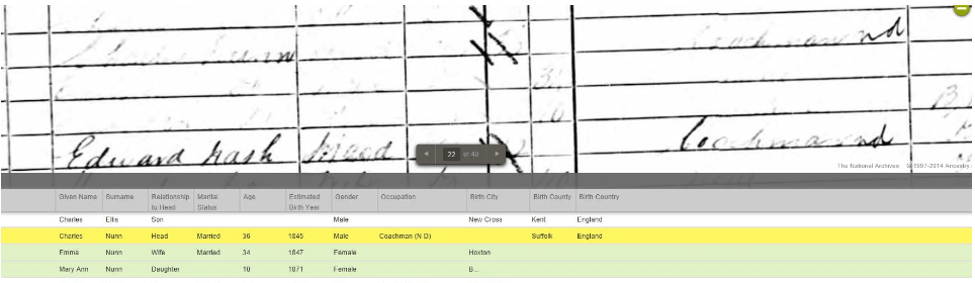
1. 1881: In the 1881 England Census [see the copy below of 1881 census], Charles Nunn, wife Emma and a young girl, Mary Ann, aged 10 are listed. She is listed as Mary Ann Nunn, but relationship is not visible. In fact, the copy of this census online is nearly unreadable, though it had been transcribed by researchers in the past, indicating the names I’ve noted above. If you adjust the contrast on the digital copy, you can just barely make out the names. Charles is noted as 36 years old, Emma 34 and Mary Ann, 10. Charles’ birthplace notes Suffolk only. Emma’s birthplace is listed as Hoxton. And young Mary Ann’s is Brompton. This would support the information that Charles and Emma Nunn were raising Mary Ann Nunn.
This second, contrast-adjusted copy helps to see what is actually there:
Or this copy where I have overwritten what is barely visible for contrast:
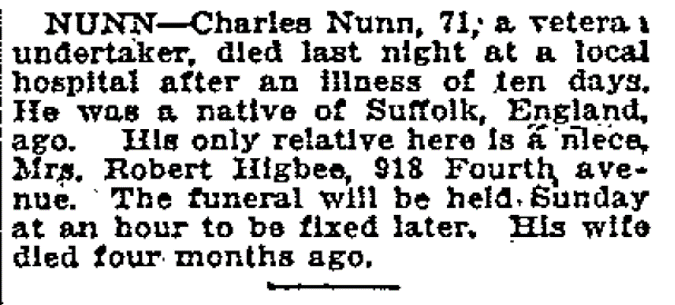
2. When Charles Nunn died in 1916 in Salt Lake City, his obituary noted that he was originally from Suffolk, England, and that his only living relative here in the U.S. was his niece, Mary Ann Nunn Higbee [note the copy of the Obituary below].
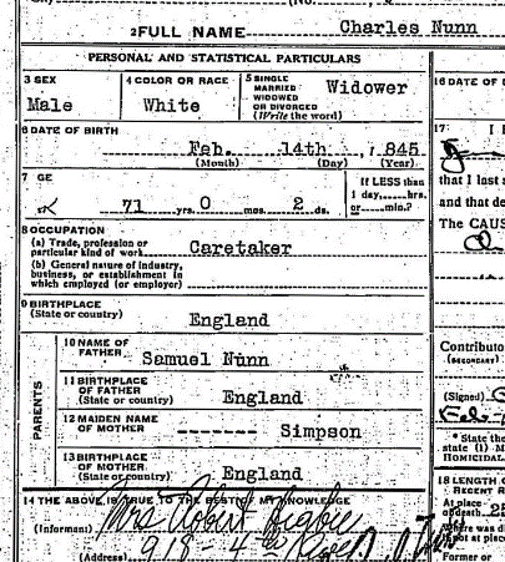
These two points connect Charles Nunn to our John Nunn, and to the Nunn family of Suffolk. With this very important connection made, Charles’ death certificate is also very important as it provides further clues to Charles’ and John’s parents.
Charles’ Utah Death Certificate in 1916 notes that his father was Samuel Nunn and his mother was ——Simpson. The informant providing this information on his death certificate was Mrs. Robert Higbee (Mary Ann Nunn, Charles’ niece). She is a great informant, as she would have been providing what information she had related to her own grandparents.
If Mary Ann was living with her Uncle Charles in 1881, where were her parents? Divorced, as noted by Marjorie Brady? Or elsewhere? A search for John Nunn and Mary Ann Moore Nunn in 1881 England census does not provide any real results for their whereabouts. Were they both deceased by that time? And where is Emma Jane Nunn, the younger sister? No definite answers are found for John, Mary Ann or Emma Jane.
So what about John and Charles’ parents?
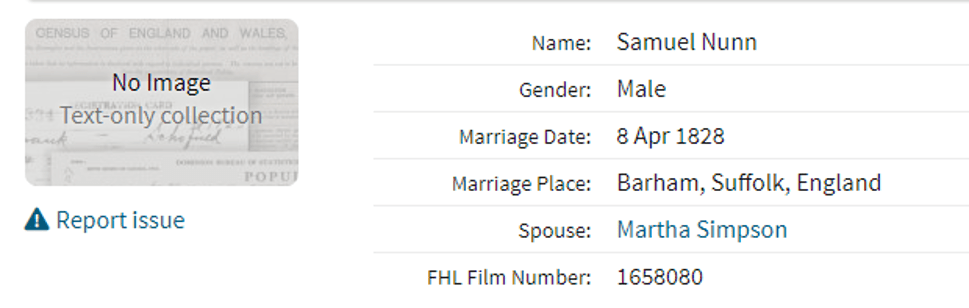
With this information, we generally assume that John and Charles Nunn’s parents are Samuel Nunn and a Miss Simpson (since her first name is not noted in Charles’ death certificate). According to both Doris Odekirk Higbee (my grandmother) and Mary Jane Purdue Salmon (a cousin), Miss Simpson was Martha Simpson. Both Doris and Mary Jane had noted Samuel Nunn married to a Martha Simpson in their genealogical records. This marriage is supported by a marriage record (found on FamilySearch) that highlights a Barham, Suffolk, England marriage of Samuel Nunn to Martha Simpson, with a marriage date of 8 April, 1828. This certainly supports the original information we have that John Nunn’s parents are Samuel Nunn and Martha Simpson. Worth noting is that Barnham, Suffolk and Needham Market, Suffolk fall within the same parish and are 5 miles from each other.
If we now look back a few years, we find a few more interesting records associated with Samuel Nunn and Martha Simpson Nunn:
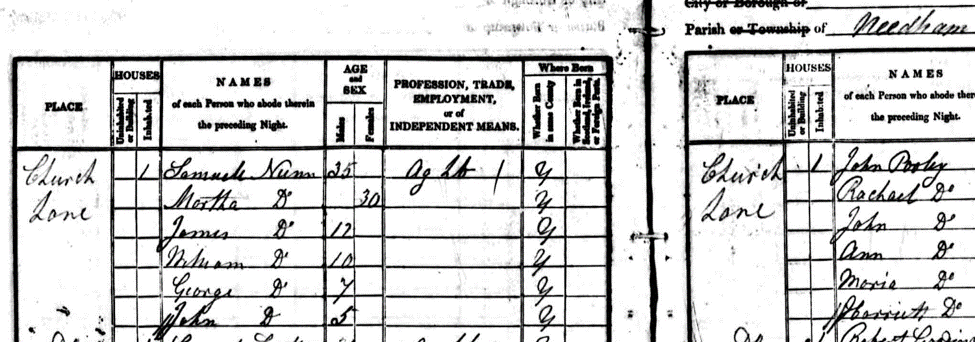
1841: The 1841 Census for Needham, Suffolk has a record for Samuel Nunn and wife Martha. Charles Nunn would not have been born yet, but a John Nunn is listed as 5 years old (indicating a birth year of 1836). Individual birth places are not listed. The other children listed match those also found ten years later in an 1851 census, except the older sons who are listed here but not in 1851 (when they likely would have been gone from home). [see below the copy of 1841 census]. Samuel’s occupation is listed as Agriculture Laborer.
1851: The 1851 Census for Barking, Hamlet of Needham, in Suffolk also has a record of Samuel Nunn, wife Martha, and numerous children, born in Needham (this ties to our earlier reference to John Nunn’s possible birth in Needham Market). Of these children, there is a John (age 13) and Charles (age 6). This John Nunn would have been born in 1838 and Charles would have been born in 1845. [see below the copy of the 1851 Barking, Needham census]. Samuel’s occupation is listed as Agriculture Laborer.
1861: By the 1861 Census for Needham Market, Suffolk, Samuel and wife Martha are still in the home, with three of the younger children, including a 16-year-old Charles, with a birth location of Needham. John Nunn would likely have been out of the house by this time. Samuel is listed as a Laborer. [see below the copy of the 1861 census].
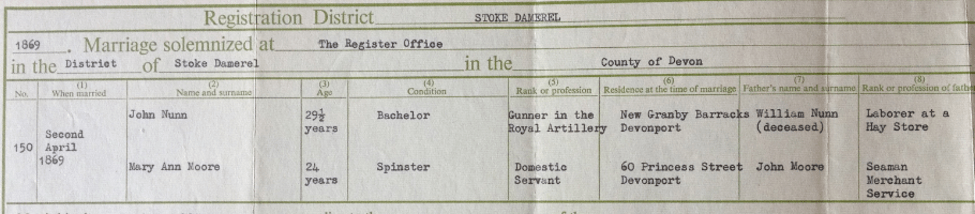
1869: In 1869, we have a marriage record for John Nunn and Mary Ann Moore, being married April 2, 1869 in Stoke Damerel, Devonshire. John Nunn is noted here as a Gunner in the Royal Artillery. [Below is a copy of the Marriage Record]
John is listed as 29 ½ years of age, placing his birth year around 1839. Is this correct? Mary Ann Moore is listed as 24 years old, making her birth year around 1845. Neither has a birth location noted in this marriage record. John’s father is listed as William – not Samuel, who was noted as deceased by this time. Father William’s occupation was listed as a Laborer at a Hay Store. With this record noting William as John’s father, and with Charles’ Death Certificate noting Samuel, there is an obvious challenge to sort through. Some have combined the two to assume Samuel William or William Samuel may be one in the same. So far, no records actually combine the two names. Both William and Samuel in various records are listed as Agriculture Laborers, so it is not an impossibility that they are the same person.
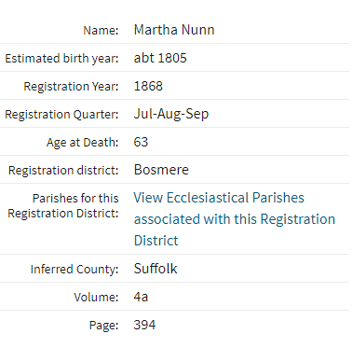
1868: Martha Simpson Nunn dies in Bosmere, near Needham Market, Suffolk. [see Copy of Death Index Record].
1871: So far, a thorough search of the 1871 census records have failed to show us information on Samuel and Charles. Were the missed or just indexed incorrectly? We will need to continue to search for this. If William and Samuel are by chance the same person, then according to the Marriage record of John Nunn and Mary Ann Moore, John’s father was already deceased by this time. So where is Charles and his younger siblings?
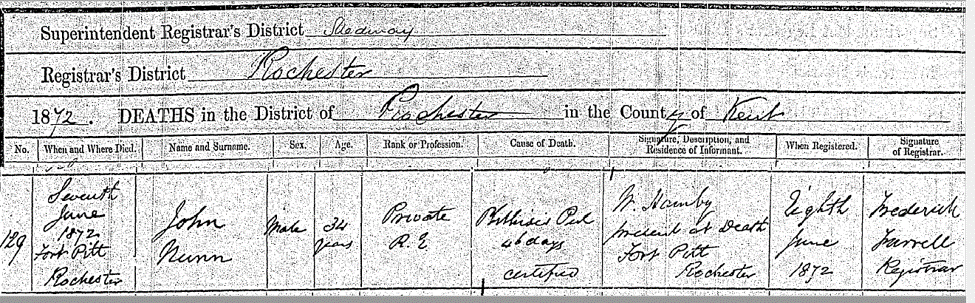
1872: From the death record found by Marian Brady, John Nunn, was noted as a Private in the Royal Engineers, of Rochester, Kent, and that he died on 7 Jun 1872 at Fort Pitt, Rochester, Kent. This career in the Royal Engineers matches what we have previously noted for John Nunn. He was listed as 34-years-old at death, making his birth year about 1838. This, too, closely matches several other records we’ve noted above. This would also explain why no 1881 census was found for John. This clearly seems to be our John Nunn [see below the copy of John Nunn’s Death Certificate].
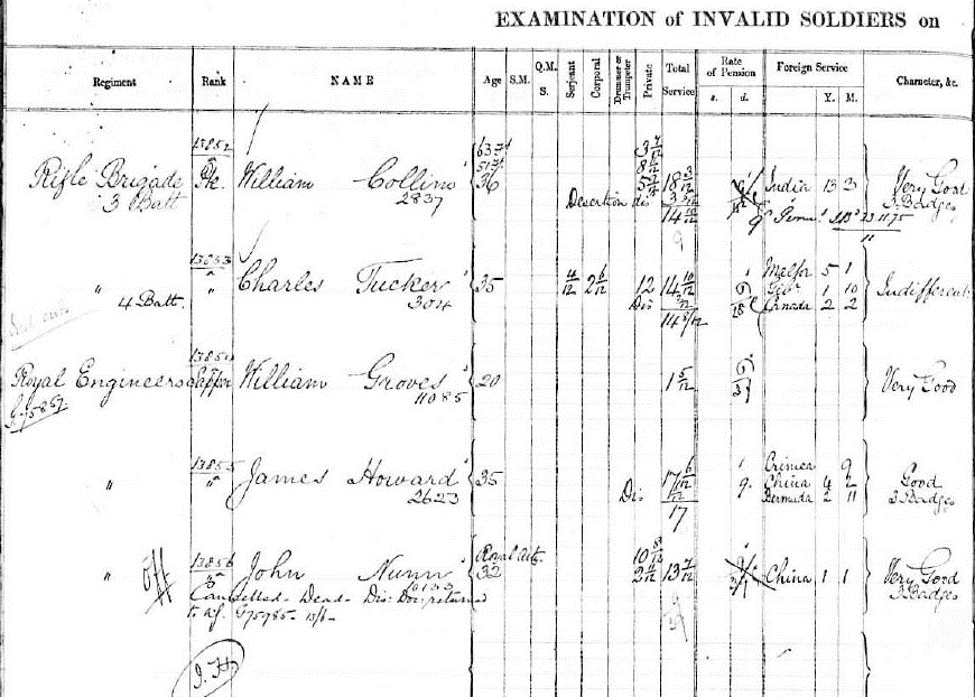
1872: That same year, in the Military Pension Record found by Marian, there is a summary of John Nunn’s military service, and a note about his death, as well as notes that indicate John Nunn was born in Needham, Suffolk. This important bit of information ties John’s birthplace to the records we have already noted for John and ties him to Samuel and Martha Simpson Nunn of Needham. He served for 13 years and 7 months, with foreign service in China. How cool is that!!! The first column indicates that he was in the Royal Engineers (see the ditto marks on the record). To the right of his name is an annotation that may indicate he was also previously in the Royal Artillery. This Is referenced next to his age of 32. This also lists his total time in the services at 13 years 7 months (perhaps 10 years and 8 months in the Royal Artillery, and 3 years 11 months in the Royal Engineers?). These two references tie to the several records we have that show he was with the Royal Engineers, but at the time of his marriage to Mary Ann Moore, had been in the Royal Artillery. [see page 1 of the copy of John’s Military Pension Record and Notation of Death].
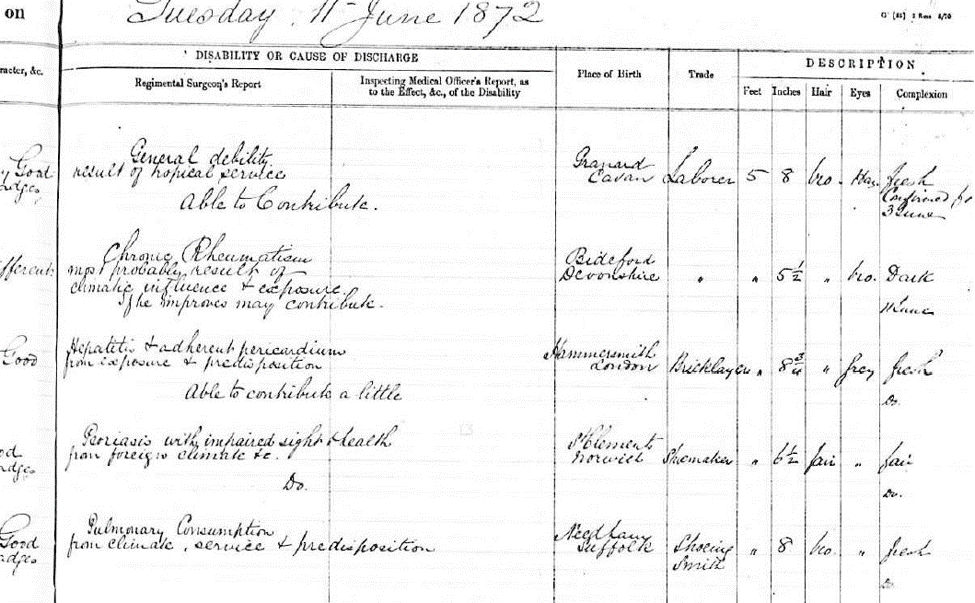
Page two of this same record is shown below. John’s reference is the last one on the page. There are a couple of important bits of information here. One, John’s birthplace is listed and Needham. That is an important connection to Samuel Nunn and Martha Simpson as John’s parent. Second, he was listed as a Shoeing Smith, with ties to an earlier census record that listed our John as a Smith. The references on the first page, and these on page two, particularly his birth location of Needham Market, clearly show this record belongs to our John Nunn. I think the connection is unmistakable. [see page two below}
Page two also indicates his discharge reason was for Pulmonary Consumption from climate, service and predisposition. He was noted as 5’8” with brown hair and a fresh complexion.
OF IMPORTANT NOTE:
Some have connected several other Military Records to our John Nunn on Family Search (the records were found on Fold3). I believe that a closer look at these other Military Papers associated with a Gunner John Nunn do not actually belong to our John Nunn. Firstly, these records indicate that this John Nunn’s full career was in the Royal Artillery; while our John Nunn spent most of his career in the Royal Engineers as a Sapper and Blacksmith. This John Nunn is noted with his Royal Artillery title, Gunner in all of these records. That is a significant difference and a key reason I believe these records are not associated with our John Nunn.
Secondly, this record lists John Nunn’s military discharge date in what appears to be 1873, which is after our John Nunn’s supposed death in 1872 (see Death Record above – 1872).
Thirdly, the total years of service for this John Nunn do not match those of the other John Nunn’s summary in his Pension records. This John’s birthplace was noted as Mildenhall, Suffolk. This contradicts all of the other information we already have seen about our John Nunn being born in Needham. These three concerns lead me to believe that this particular John Nunn is a different person from our John Nunn and that trying to connect our John Nunn to the parents of John Nunn of Mildenhall is not a correct assumption.
Cumulatively, I believe there is substantial evidence here to demonstrate that the parentage that Doris Odekirk Higbee and Mary Jane Salmon have previously noted for John Nunn and his brother Charles, is most likely correct. We still do not have an answer as to why the name Samuel is noted in some cases, and William on a marriage certificate, but I believe the ties to Samuel Nunn and Martha Simpson Nunn in the Needham Market, Suffolk areas seems mostly substantiated. While there is clearly another William Nunn, with a son John, in the Mildenhall, Suffolk area, I do not see enough other evidence to suggest that that family is the one belonging to our John Nunn. There are also other Nunns in the Bury St Edmonds area of Suffolk that one could easily confuse with our John Nunn and Mary Ann Moore. The John and Mary Ann Nunn of Bury St Edmonds even had a daughter Mary Ann, but this is not the same family as our John and Mary Ann. That John was not in the Military and lived well after our own John had died. The Bury St Edmonds Nunns are not directly tied this our Nunn family.
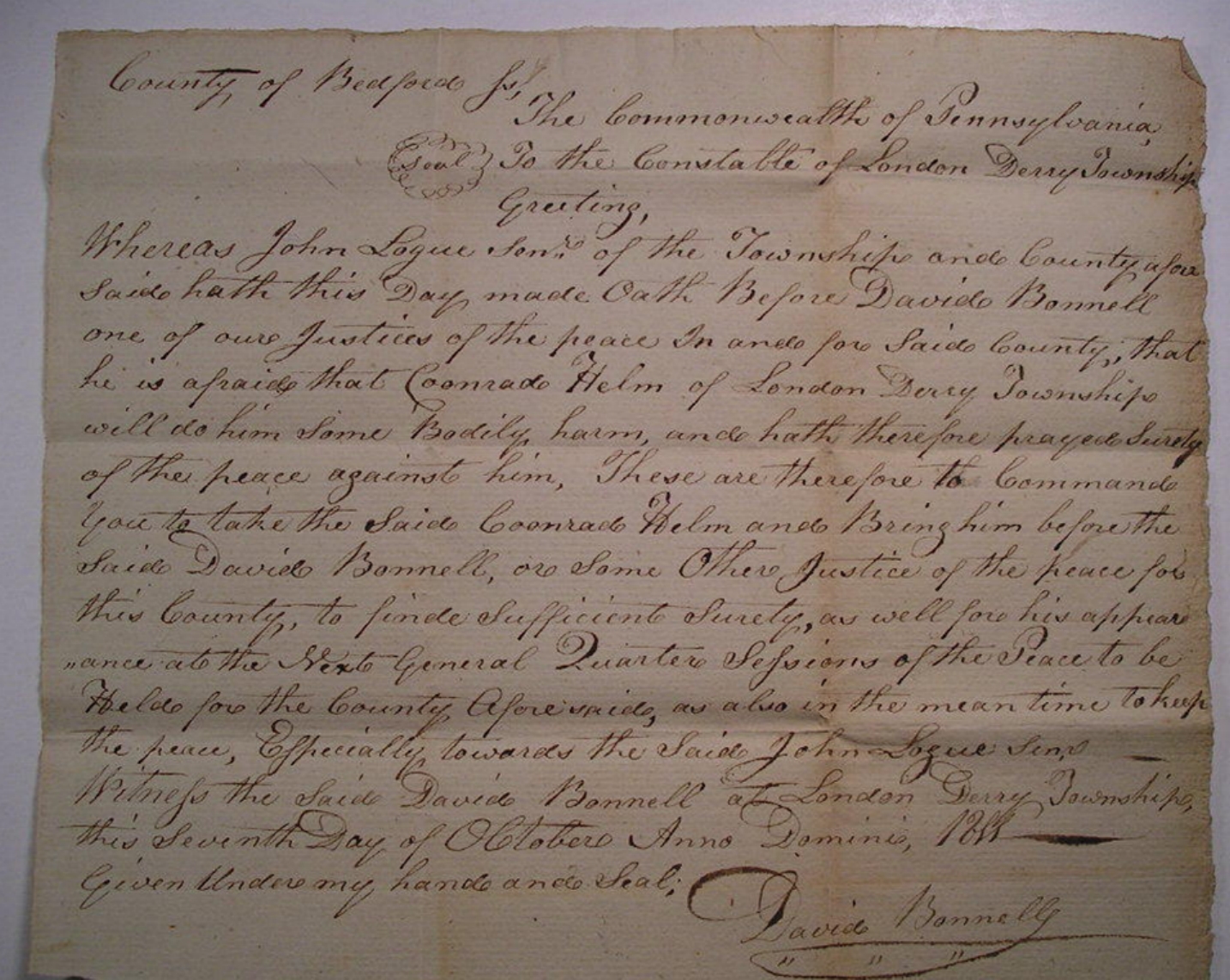
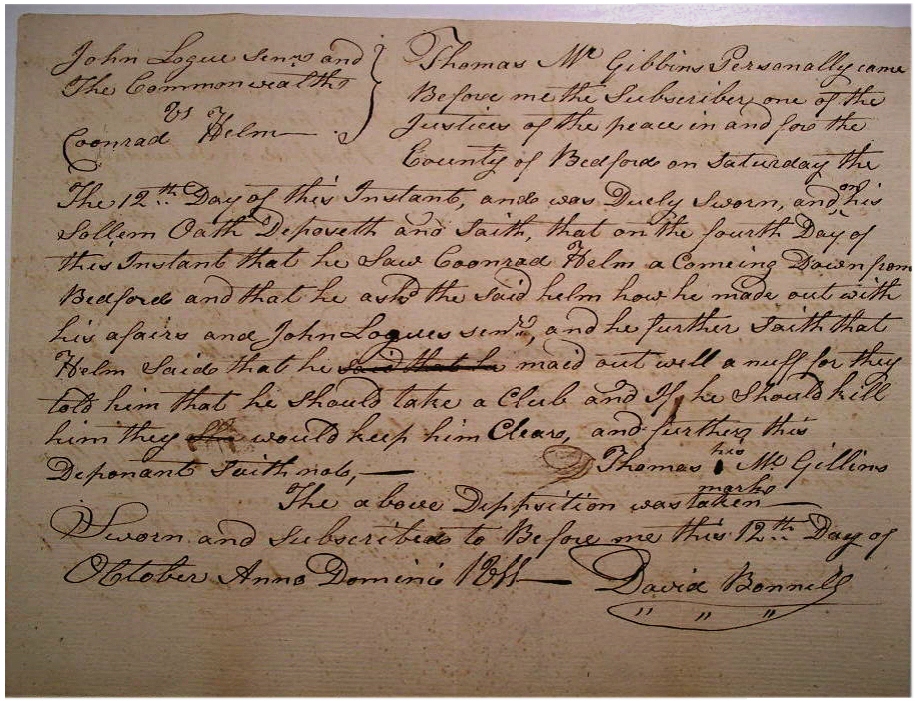
What bit of intrigue sparked the debate between these two Londonderry neighbors? We may never know, but clearly, in the following court documents, Conrad Helm was not very happy about something as it related to my 4th Great Grandfather, John Logue Sr., of Bedford County, Pennsylvania. Peruse the transcribed notes of the following documents (I purchased one of these original documents several years ago; while the other two were eventually sold on eBay for an amount greater that I was able to afford).
Document 1:
County of Bedford of the Commonwealth of Pennsylvania to the constable of London Derry Township, greeting,
Whereas John Logue Senior of the township and county afore said hath this day made oath before David Bonnell one of our justice of the peace in and for said county, that he is afraid that Coonrad Helm of London Derry Township will do him some bodily harm, and hath therefore prayed surety of the peace against him, these are therefore to command you to take the said Coonrad Helm and bring him before the said David Bonnell or some other justice of the peace for this county, to find sufficient surety as well as for his appearance at the next general quarter session of the peace to be held for the county afore said, is also in the meantime to keep the peace, especially toward the said John Logue senior.
Witness this said David Bonnell at London Derry Township this seventh day of October Anno Domino 1811
Given under my hand and seal David Bonnell
Document 2:
October the Seventh Anno Domino 1811
John Logue Senior personally came before me, David Bonnell one of the justices of the peace in and for the county of Bedford, and was duly sworn, and on his solemn oath deposeth and saith, that Coonrad Helm has lately, repeatedly threatened that he would take his life, and that the said Conrad Helm ordered his wife Mary Helm to fetch him his gun and swore that he would kill him, and that he verily believes that he goeth in danger of his life, and that he doth not require a surety of the peace for malice, vexation and revenge, but purely for his ownly safety,
Conrad Helm (the Principal) bound in Two Hundred Dollars to appear at the next court of general quarters of the peace to be held at Bedford borough for the county of Bedford and George P Schultz (the Surety) bounds in Two Hundred Dollars,
Coonrad Helm of London Derry Township Bedford County, mason, tent in $200 George P Schultz of the same place yeoman tent in $200
Upon conditions, that if this said Coonrad Helm shall personally appear at the next court of general quarter sessions of the peace to be held at Bedford burough in and for the county of Bedford then and there to answer such matters and things as shall be objected against him, on behalf of the Commonwealth, for breaking the peace by threatening the life of a certain Jon Logue Senior, and shall in the meantime keep the peace, and be of good behaviors toward all the liege subjects of the Commonwealth, especially toward John Logue Senior, and not depart the said court without license then the above recognizance to be Void, otherwise the several sums of money to be levied of their goods and chattels, lands and tenements, respectively to the use of the Commonwealth.
Taken and acknowledged the 12th Day of October AD 1811
David Bonnell
Document 3:
John Logue Senior and the Commonwealth versus Conrad Helm
Thomas McGibbons personally came before me the subscriber one of the justices of the peace in and for the county of Bedford on Saturday the 12th day of this instant and was duly sworn in on his solemn oath deposeth and saith that on the fourth day of this instant that he saw Conrad Helm a coming down from Bedford and that he asked the said Helm how he made out with his affairs and John Logue senior, and he further saith that Helm said that he made out well enough for they told him that he should take a club and if he should kill him they would keep him clear, and further this deponent saith not.
Thomas McGibbons
The above deposition was taken sworn in subscribed to before me the 12th day of October Anno Domino 1811 David Bonnell













 Discover the Dash